
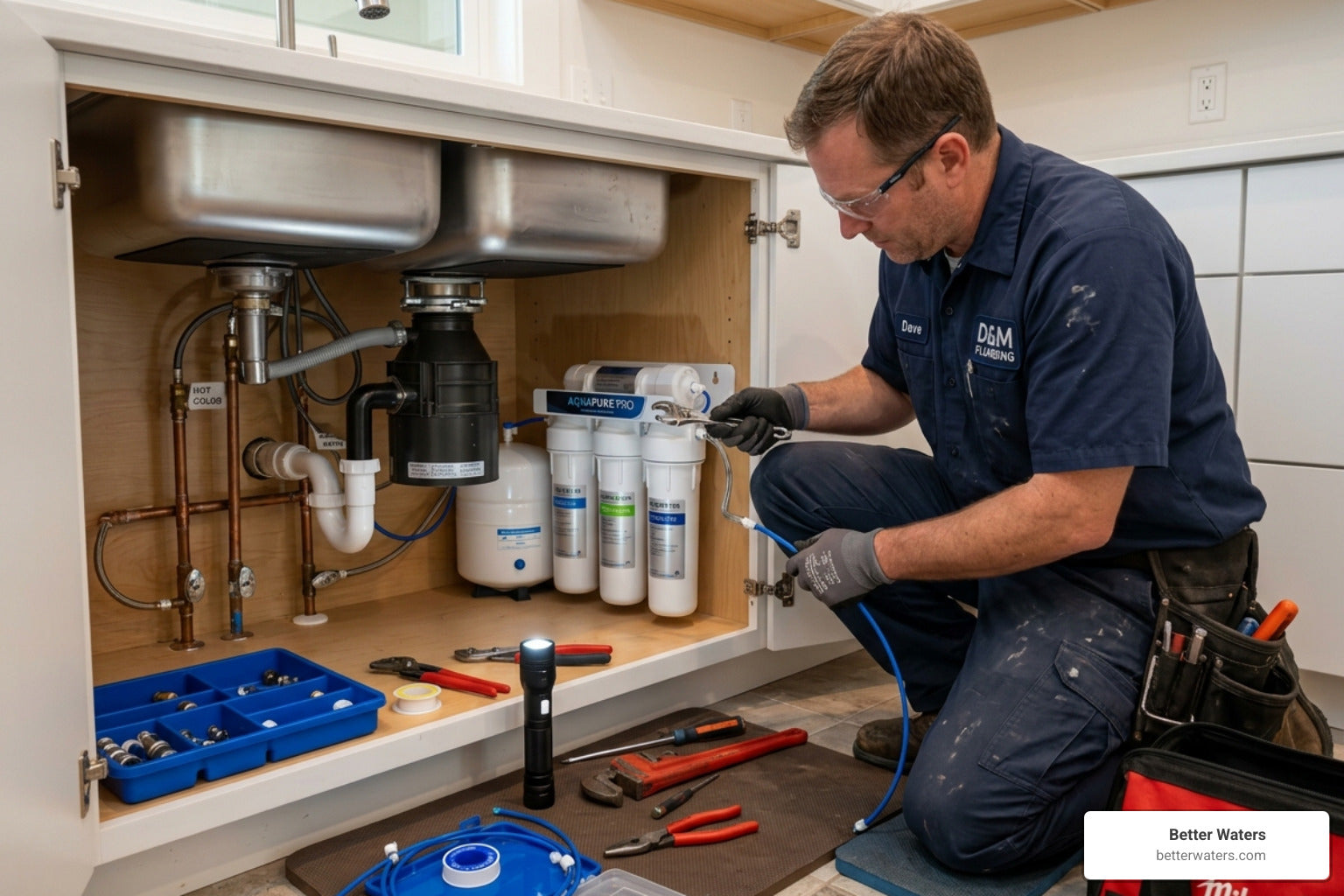
What Does It Cost to Install an Under-Sink Water Filter?

The cost to install under sink water filter systems typically falls between $100 and $3,000, with most homeowners paying around $550 on average.
Here's a quick breakdown by system type:
| Filter Type | System Cost | Installation (Labor) | Total Estimated Cost |
|---|---|---|---|
| Sediment/Single-Stage | $50–$150 | $100–$200 | $100–$300 |
| Carbon Block (Multi-Stage) | $150–$500 | $150–$400 | $300–$900 |
| Reverse Osmosis (RO) | $200–$800 | $200–$600 | $300–$2,000 |
| UV Disinfection System | $300–$1,000 | $300–$700 | $500–$3,000 |
Labor rates vary by region. Plumbers typically charge $45–$200 per hour.
So you're done with the taste of tap water. Maybe you've spotted lead, chlorine, or other contaminants in your local water quality report. Or you're just tired of hauling plastic bottles home every week.
An under-sink water filter is one of the most practical upgrades a homeowner can make. It's out of sight, always on, and delivers filtered water straight from the tap.
But before you buy, you need to know what you're actually getting into — not just the sticker price of the filter, but the full cost to get it running properly in your home.
The numbers can surprise you. A basic single-stage filter might run you under $200 all-in. A professionally installed multi-stage carbon or reverse osmosis system can push past $1,000 once you factor in labor, fittings, and a dedicated faucet.
This guide breaks down every cost involved — so you can budget clearly and choose the right system for your home.

Breaking Down the Cost to Install Under Sink Water Filter Systems
When we look at the financial landscape of home water treatment in April 2026, the cost to install under sink water filter systems remains a top-tier investment for health and convenience. While the median price sits at $550, the wide range from $100 to $3,000 reflects the massive difference between a simple sediment "polishing" filter and a high-end, multi-stage purification powerhouse.
System complexity is the primary driver here. A basic unit might just clip onto your cold water line, while advanced systems require mounting, possibly a dedicated faucet installation (not required with the XL7000), and sometimes even electrical work (also not applicable for the XL7000). Whatever the installation demands, the investment inevitably pays for itself when you consider the superior water quality and the cost-savings of switching from plastic water bottles to an under-sink water filter.
At Better Waters, we believe the "sweet spot" for most households is high-performance activated carbon filtration. Activated carbon is the backbone of modern water treatment. It's incredibly effective at removing chlorine, bad tastes, and odors. Our XL7000 Water Filtration System takes this a step further by using 3M-developed, multi-stage technologies. It provides bottled-quality water without the water waste or slow flow rates often associated with more expensive Reverse Osmosis (RO) setups. If you are still asking yourself, "Do I need an under-sink water filter?" consider that these systems offer the most direct path to safer drinking water at a fraction of the cost of unnecessarily expensive water technologies.
Understanding Filtration Technologies and Their Costs
Not all filters are created equal, and your wallet will feel the difference:
- Sediment Filters ($100–$300 total): These are the most basic. They primarily catch physical particles like rust, sand, and dirt. They are cheap to buy and fast to install, but they won't help with chemical tastes or heavy metals.
- Advanced Multi-Stage Carbon Filtration ($300–$1,500 total): This is where systems like our XL7000 live. These systems use dense carbon blocks and specialized membranes to target a wide array of contaminants including lead, cysts, and chemicals. Because they often include high-capacity cartridges (like our 6,000-gallon capacity unit), they offer a professional-grade solution that balances high performance with reasonable installation costs.
- Reverse Osmosis (RO) ($300–$2,000 total): RO systems are highly effective but complex. They require a storage tank, a drain line connection, and multiple filter stages. This complexity drives up both the equipment price and the plumber's labor time.
When choosing, always look for NSF certifications. These are the gold standard in the industry, proving that the system actually does what the manufacturer claims. A multi-stage system that carries these certifications ensures you aren't just buying "peace of mind," but actual, verified contaminant reduction.
Regional Labor Rates and Professional Installation Costs
Where you live in the New York City area significantly impacts your final bill. In a high-demand market like Manhattan, plumber labor rates typically range from $100 to $300 per hour, with many licensed professionals in the city leaning toward the higher end of that scale due to travel time, parking, and insurance requirements.
In high-rise apartments or older brownstones, you might also face:
- Travel/Service Fees: Many NYC plumbers charge a flat fee just to show up (often $100–$150), which is then applied to the first hour of labor.
- Permit Costs: While most under-sink installs don't require a permit, certain complex modifications to the main plumbing line in commercial or multi-family buildings might trigger local code requirements.
- Zip Code Variations: Even within the five boroughs, prices can fluctuate. A "simple" install in a modern condo might take 30 minutes, while an install in an older building with corroded pipes could take two hours or more.
Key Factors Influencing Your Total Installation Bill

Beyond the type of filter you choose, several "hidden" factors can move the needle on your cost to install under sink water filter projects.
- Plumbing Age: If your home was built pre-1980, your pipes might be made of materials that are harder to work with, such as galvanized steel or older copper that has become brittle. Plumbers often need to install new shutoff valves or adaptors to bridge the gap between old plumbing and modern filter connections, which adds time and material costs.
- Water Testing ($10–$400): Consider testing your water before buying a system. For example, there is no point buying a $2,000 UV system if your only issue is a slight chlorine taste. It's also true that in a large city like New York, the water quality issues are well established and predictable. If you decide to invest in water testing, remember that a basic DIY kit is cheap, whereas a professional laboratory analysis will give you the data needed to choose the right tool for the job. You can find more details on why this matters in our guide on 6 reasons to install an under-sink water filter.
- Dedicated Faucets vs. Inline: Do you want a small, separate tap for your filtered water, or do you want the filter to treat all the cold water coming out of your main kitchen faucet? Dedicated faucets require drilling a hole in your countertop (which is risky and expensive if you have granite or marble), while inline systems like the XL7000 can often be connected directly to your existing cold water line, maintaining a high flow rate of up to 2.5 GPM.
- Flow Rates and Capacity: Systems with higher GPM (gallons per minute) capacities generally cost more because they use larger, more advanced filter media to ensure the flow rate isn't reduced too much when you turn on the tap.
Long-Term Maintenance and Operating Expenses
The "installation" cost is only the first chapter. To keep your water clean, you have to account for ongoing maintenance.
- Filter Lifespan: Most standard carbon filters last 6 to 12 months. However, high-capacity systems like the Better Waters XL7000 are designed to handle up to 6,000 gallons, which for most households means only one filter change per year.
- Replacement Costs: Individual cartridges can range from $15 to $800. While a higher-end filter sounds pricey, if it lasts a full year and replaces thousands of plastic bottles, the math works in your favor.
- System Longevity: A well-maintained under-sink housing can last 10 to 20 years. The only parts that typically wear out are the O-rings (which cost pennies) and the cartridges themselves.
Because carbon filtration systems don't require electricity (unlike UV or some RO booster pumps) and don't waste water down the drain, their operating costs are remarkably low. You're essentially just paying for the replacement media.
DIY vs. Professional Under-Sink Water Filter Installation
One way to slash the cost to install under sink water filter systems is to do it yourself. DIY installation can save you 30% to 50% on the total project cost by eliminating labor fees.
Most modern systems, including our XL7000, are designed for "plug-and-play" installation. If you have basic tools like a pliers and a screwdriver, and you're comfortable working in tight spaces under the sink, you can likely handle the job in about an hour.
However, there are risks to the DIY route:
- Warranty Protection: Some manufacturers only honor warranties if the system was installed by a licensed professional.
- Leak Liability: If a DIY connection fails while you're at work, the resulting water damage to your kitchen cabinets and floors could cost thousands. A professional plumber carries insurance for exactly this reason.
- Code Compliance: In New York City, certain plumbing modifications must meet specific codes to ensure the safety of the building's water supply.
If you are still on the fence, check out our insights on do I need an under sink water filter to see if a simple or complex system fits your lifestyle.
When to Call a Pro for Your Under-Sink Filter Installation
We generally recommend hiring a professional if:
- You have complex plumbing: If your under-sink area is a "spaghetti mess" of pipes, dishwasher lines, and garbage disposals, a pro can navigate it safely.
- You need to drill through stone: Drilling a hole in a granite, quartz, or marble countertop for a dedicated faucet is a high-stakes task. If the stone cracks, you're looking at a very expensive kitchen remodel.
- You want "Peace of Mind": Knowing that a licensed plumber from New York NY or Manhattan has pressure-tested every fitting is worth the labor cost for many homeowners.
For a professional-grade implementation like the XL7000, an expert install ensures you get the full 2.5 GPM flow rate and that the multi-stage carbon block technology is performing at its peak from day one.
Frequently Asked Questions about Under-Sink Filter Costs
Is an under-sink water filter worth the investment, especially a multi-stage carbon system like the XL7000?
Absolutely. When you compare the cost to install under-sink water filter systems against the price of bottled water, or the uncertainty of unfiltered tap water, the ROI is clear. A system like the XL7000 provides 6,000 gallons of water — equivalent to over 45,000 standard 16.9oz plastic bottles. The savings in the first year alone often cover the entire installation cost.
How often do I need to replace the filters for my Better Waters system?
For the XL7000, we recommend replacing the cartridge about once a year, or sooner if you think you have produced more than 6,000 gallons of filtered water before. In areas with very high sediment, you might notice a drop in water pressure sooner, which is your signal that the multi-stage carbon block has done its job and is full of captured contaminants.
Do I need a permit for installation?
In most residential settings in New York City, a standard under-sink filter installation that uses a T-valve on an existing line does not require a plumbing permit. However, if you are rerouting major pipes or installing a system in a commercial space in Manhattan, it is always best to consult with a local licensed plumber to ensure compliance with NYC building codes.
Conclusion
Investing in your home's water shouldn't be a guessing game. While the cost to install under sink water filter systems can vary, focusing on high-quality, high-capacity solutions ensures the best value for your dollar.
The Better Waters XL7000 stands out as a practical, advanced solution for New York residents. With its 6,000-gallon capacity, 2.5 GPM flow rate, and 3M-developed technology, it offers the performance of a complex system with the simplicity of a single-cartridge design. It is NSF-certified to provide the peace of mind you need, delivering crisp, clean water directly to your tap without the bulk or waste of most traditional systems.
Ready to upgrade your kitchen? Explore the XL7000 Water Filtration System today and take the first step toward professional-grade water in your own home. Our team is here to help you navigate the best filtration options for the unique water challenges of the New York City area.
Share:
What Does an NSF Approved RO Filter Actually Do
Don't Lose Your Deposit with These Renter Friendly Water Filters