
What Is Carbon Water Filtration and How Does It Work?
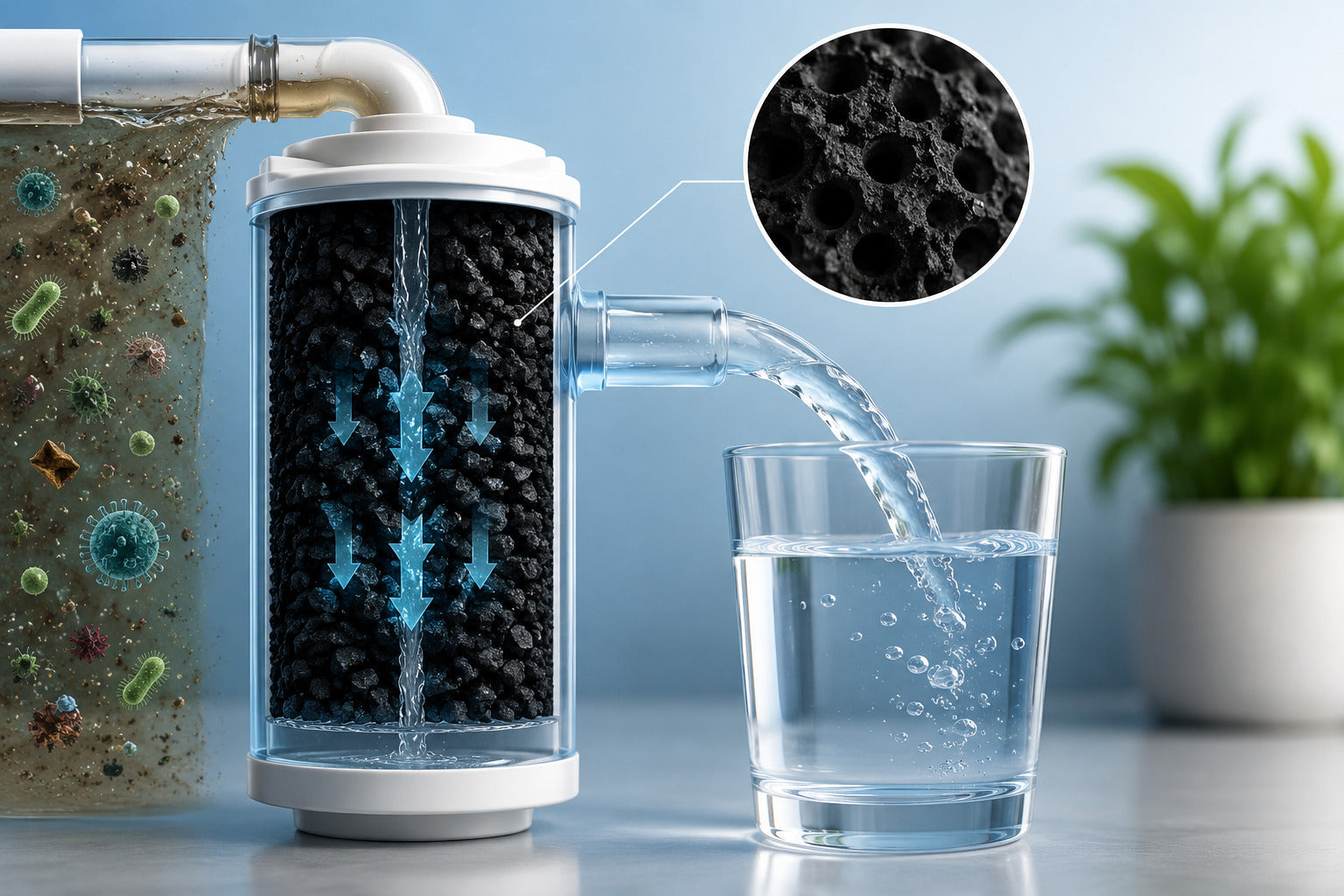
How carbon water filtration works is simpler than most people think, and understanding it can change how you think about every glass of water you drink.
The short answer:
- Water passes through a bed of activated carbon, a highly porous material with an enormous internal surface area
- Contaminants like chlorine, VOCs, pesticides, and PFAS stick to the carbon's surface through a process called adsorption
- Clean, better-tasting water flows through, with beneficial minerals like calcium and magnesium left intact
- Over time, the carbon fills up and must be replaced to maintain performance

That's the core mechanism. But the details (the type of carbon used, the filter design, the flow rate, the pore size) make a huge difference in how well a system actually protects you.
One striking fact puts it in perspective: a single gram of activated carbon has a surface area exceeding 3,000 square meters, roughly the size of a football field. That massive surface area is what makes carbon such a powerful purifier in a compact form.
For health-conscious homeowners tired of bad-tasting tap water, plastic bottle waste, and uncertainty about contaminants like lead and cysts, carbon filtration is often the foundation of the solution. Modern multi-stage systems, like the Better Waters XL7000 Water Filtration System, build on these core principles to deliver professional-grade purification right under your sink.
This guide breaks down exactly how the science works, what it removes, and what to look for in a high-performance system.
The Science of Adsorption: How Carbon Water Filtration Works
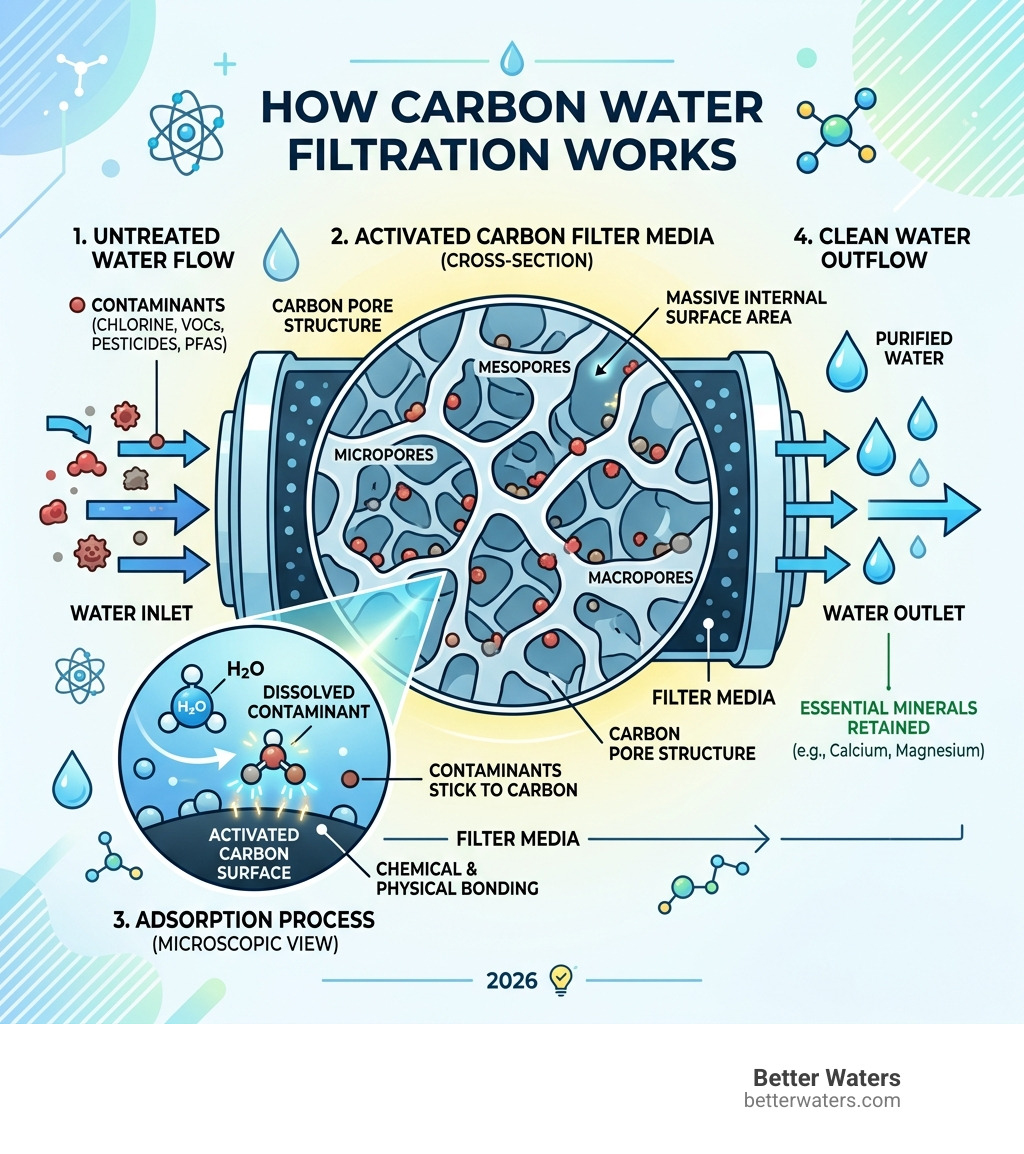
To truly grasp How Carbon Water Filtration Works, we have to look at the microscopic level. Many people confuse "absorption" with "adsorption." Think of a sponge soaking up water; that is absorption. Adsorption, however, is more like Velcro or a magnet.
In Carbon Filter in Water Treatment: Essential for Purification, the process is described as a surface phenomenon. As water flows through the carbon, dissolved contaminants are drawn to the surface of the carbon granules or block. They "stick" to the walls of the millions of tiny pores within the carbon.
This sticking power comes from Van der Waals forces, which are weak intermolecular attractions. Because activated carbon has such an astronomical amount of surface area, there are billions of "sticky" sites available to grab hold of organic compounds.
Beyond just grabbing particles, carbon also performs chemical reduction. This is how it handles chlorine. Instead of just "trapping" the chlorine, the carbon surface acts as a catalyst to change the chemical structure of chlorine into harmless chloride ions. This is why carbon-filtered water suddenly loses that "swimming pool" smell and taste.
Why Pore Size Matters: How Carbon Water Filtration Works for Microplastics
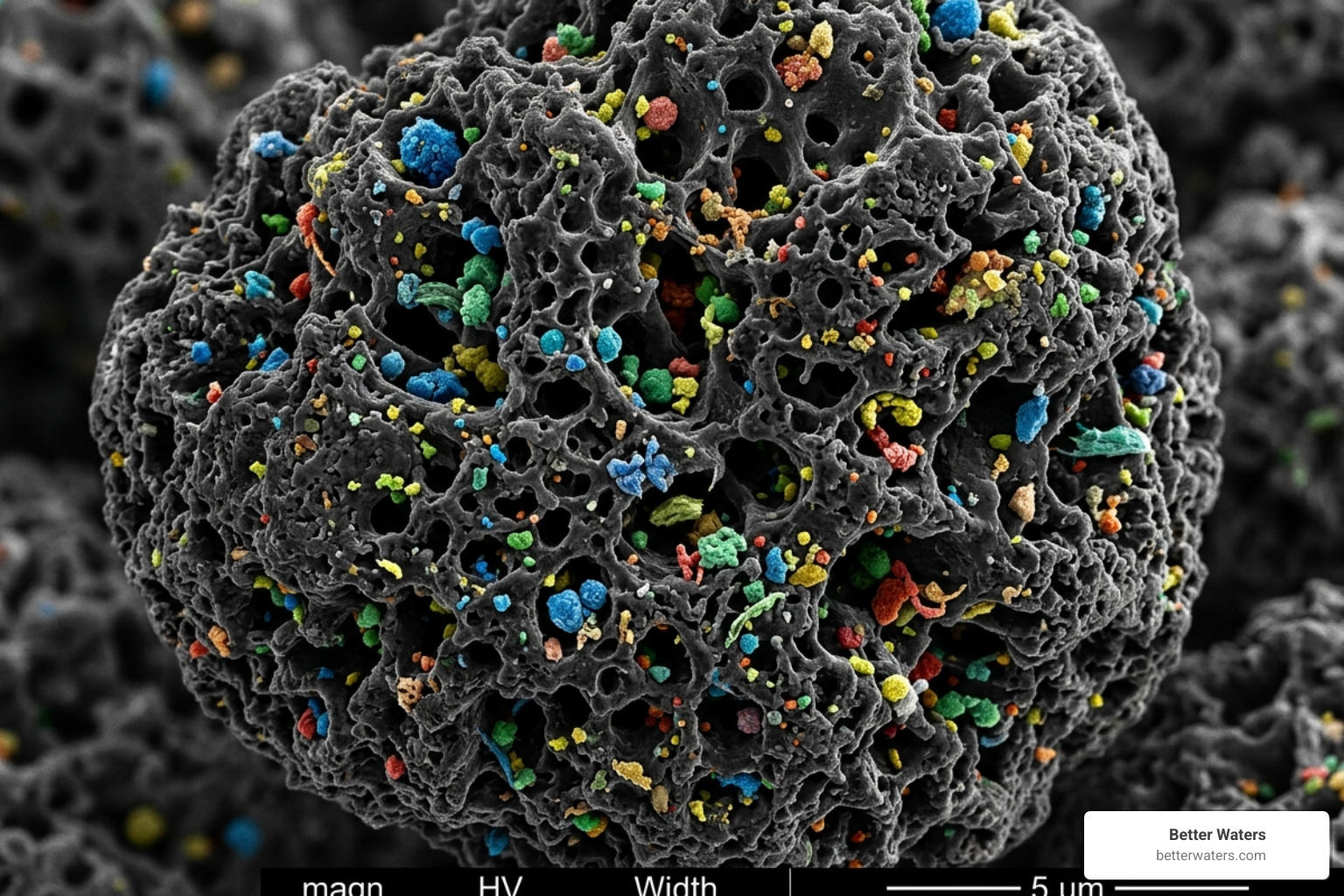
Not all carbon filters are created equal. The effectiveness of the filter is often dictated by its micron rating. This refers to the size of the "holes" or pores in the filter media.
- Micropores: These are the smallest pores (less than 2 nanometers), perfect for capturing small molecules like THMs, VOCs and chlorine.
- Mesopores: Mid-sized pores that act as the "highways" for contaminants to reach the inner micropores.
- Macropores: The largest pores that allow water to enter the carbon structure and trap larger sediment.
In high-density environments, where aging infrastructure can introduce microplastics and fine sediment into the lines, pore size is critical. Advanced systems like our Better Waters XL7000 utilize optimized pore structures. By using specialized 3M technology, these systems can mechanically trap particles as small as 0.2 micron, effectively removing 99.99% of protozoan cysts and significantly reducing microplastics that standard pitcher filters might miss.
Maximizing Contact Time: How Carbon Water Filtration Works in Practice
In water engineering, we talk about EBCT (Empty Bed Contact Time). This is a fancy way of saying: "How long does the water actually touch the carbon?"
If water rushes through a filter too fast, the contaminants don't have enough time to "stick" to the surface. It’s like trying to grab a prize from a moving carousel; if the carousel is spinning at 100 mph, you’re going to miss.
How Carbon Water Filtration Works most effectively is when the flow rate is balanced with the volume of carbon. If the flow is too high, you hit the breakthrough point sooner: this is when contaminants start "leaking" through because they didn't have time to be adsorbed.
The XL7000 is engineered for this exact balance. Even with a high flow rate of 2.5 gallons per minute (GPM), which is fast enough to fill a pot for pasta in seconds, the internal multi-stage design ensures that every drop has sufficient contact time with the high-performance carbon media.
From Raw Material to Purifier: The Activation Process
Activated carbon doesn't just grow on trees, though it often starts there! Most high-quality carbon comes from organic, high-carbon materials like coconut shells, wood, or coal.
According to Drinking Water Treatment: Activated Carbon Filtration, the "activation" happens through a two-step process:
- Carbonization: The raw material (like coconut shells) is heated to incredibly high temperatures (up to 2300°F) in a vacuum without oxygen. This drives off impurities and leaves behind a charred skeleton of carbon.
- Activation: The char is then exposed to oxidizing gases like steam or carbon dioxide at high heat. This "erodes" the internal structure, creating the millions of microscopic pores that give the carbon its massive surface area.
At Better Waters, we prefer coconut shell carbon. Not only is it a renewable resource, but it also has a higher density of micropores compared to coal-based carbon. This makes it significantly more effective at removing the specific types of organic chemicals and disinfection byproducts often found in municipal water supplies in Manhattan and Brooklyn.
Comparing Filter Designs: GAC vs. Carbon Block
When shopping for a filter, you'll likely see two main types: Granular Activated Carbon (GAC) and Carbon Block.
| Feature | Granular Activated Carbon (GAC) | Carbon Block |
|---|---|---|
| Structure | Loose granules (like sand) | Solid, compressed block |
| Channeling | High risk (water finds the easiest path) | Virtually zero risk |
| Contact Time | Variable and often lower | High and consistent |
| Particle Filtration | Limited | Excellent (acts as a physical barrier) |
| Surface Area | Lower per cubic inch | Up to 10x higher than GAC |
GAC filters are common in cheap pitchers. The problem? Channeling. Over time, water pushes the granules aside and creates a "channel." Once that happens, the water flows through the gap without ever touching the carbon.
As we discuss in our In-Depth Essay: What to Understand When Choosing a Filter, carbon block technology is superior for home use. A carbon block is made of fine carbon powder compressed into a solid form. Water is forced to move through the entire structure, ensuring maximum contact. The XL7000 uses this high-performance block technology, which is why it can handle a massive 6000-gallon capacity while maintaining bottled-quality taste.
Contaminant Removal: What Carbon Can and Cannot Do
Understanding How Carbon Water Filtration Works also means knowing its limits. Carbon is a "specialist": it is world-class at removing some things, but it isn't a magic wand for everything.
What Carbon Removes Effectively:
- Chlorine & Chloramines: The primary chemicals used by NYC DEP to disinfect water.
- VOCs (Volatile Organic Compounds): Including benzene and trichloroethylene.
- THMs (Trihalomethanes): Byproducts of the interaction between chlorine and organic material in water.
- PFAS ("Forever Chemicals"): Carbon filters can remove roughly 73% to 99% of these, depending on the design.
- Pesticides & Herbicides: The EPA identifies carbon as the only media that removes all 12 identified herbicides and 14 pesticides.
- Taste & Odor: Specifically that "earthy" or "metallic" funk.
What Carbon Does NOT Remove:
- Dissolved Minerals: It won't remove calcium or magnesium (which is actually a good thing for taste!)
- Hardness: Carbon is not a water softener.
- Nitrates & Fluoride: These require different technologies like Reverse Osmosis or specialized resins.
- Heavy Metals (Standard Carbon): Standard GAC doesn't remove lead well.
However, this is where multi-stage systems shine. For more info, see About NSF Certification. Systems like the XL7000 don't just use a "bag of carbon." They use a multi-stage approach where the carbon is specially treated or combined with other media to tackle lead and heavy metals, providing a much broader shield than a simple charcoal filter.
Modern Implementation: The XL7000 Multi-Stage System
The Better Waters XL7000 is the practical answer to the question: "How do I make this science work for my family?"
While a basic carbon filter is a good start, the XL7000 is a professional-grade implementation of these principles. Developed with 3M technology, it moves beyond simple adsorption.
- 6000-Gallon Capacity: Most pitcher filters last for 40 gallons. The XL7000 lasts for 6000. That’s the equivalent of 45,000 plastic water bottles.
- High Flow Rate: At 2.5 GPM, you don't have to wait for a slow trickle to fill your coffee maker.
- Space-Saving Design: It fits under your sink in apartments where every inch of cabinet space is precious.
- Sanitary Quick Change: You don't have to touch messy, "slimy" filter media. The entire encapsulated cartridge twists out and a new one twists in, ensuring no internal contamination during the swap.
By integrating sediment pre-filtration with a high-density carbon block, the XL7000 provides a comprehensive solution that addresses the specific water quality challenges of the New York City region. Upgrade to the XL7000 Water Filtration System to experience the difference of professional-grade filtration in your own home.
Frequently Asked Questions (FAQ)
How often should I replace my carbon filter?
This is the most common question we get at our New York office. In a carbon filter, the "sites" for adsorption eventually get filled up. Once they are full, the filter is "exhausted."
For the XL7000, we recommend replacement every 12 months or after 6000 gallons, whichever comes first. If you notice a return of that chlorine smell or a significant drop in water pressure, it’s a sign the carbon block has done its job and is ready for a fresh start.
Does carbon filtration remove healthy minerals?
One of the biggest advantages of How Carbon Water Filtration Works is that it is selective. Unlike Reverse Osmosis (RO), which strips everything out of the water and can leave it tasting "flat" or "dead," carbon filtration preserves dissolved minerals like calcium, magnesium, and potassium. These minerals healthy to consume and are what give high-quality spring water its refreshing taste. The XL7000 gives you "bottled-quality" water that still contains the minerals your body needs.
Can I use carbon filters with hot water?
No! This is a critical rule for any carbon system. Carbon filters are designed for cold water lines only. High temperatures (above 100°F) can cause the pores in the carbon to expand, potentially releasing trapped contaminants back into the water stream. Hot water can also damage the binders used in carbon blocks. Always install your filtration system on the cold water line, typically under the kitchen sink before the water reaches your faucet.
Conclusion
Understanding How Carbon Water Filtration Works empowers you to make better choices for your home and health. It’s a beautiful blend of chemistry and physics, using the natural power of "activated" organic materials to scrub away modern chemical pollutants.
In a city like New York, where we pride ourselves on our water but still face challenges with aging pipes and disinfection byproducts, a high-performance carbon system isn't just a luxury: it's a smart layer of protection.
If you're ready to stop buying plastic bottles and start enjoying crisp, clean water from your own tap, it's time to look at a system that puts this science to work. Check out our guide on Choosing a Water Filter to see how different technologies compare.
Ready for the ultimate upgrade? Upgrade to the XL7000 Water Filtration System today and experience the difference that professional-grade carbon filtration makes.
Share:
How to Remove Microplastics from Water in 5 Easy Steps
Don't Let Lead Get Ahead with These Certified Filtration Solutions