
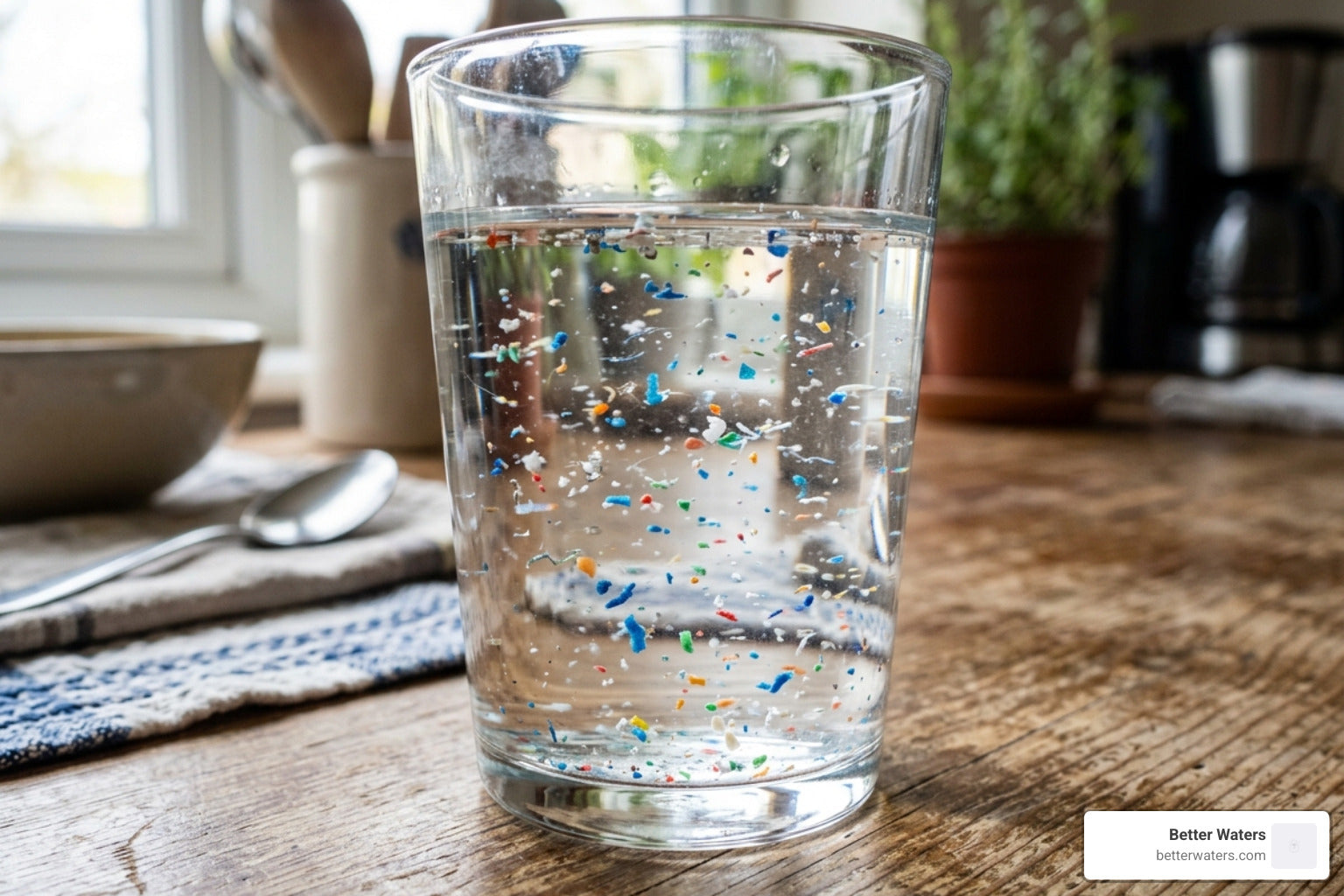
Microplastics Are in Your Drinking Water: Here's How Filters Remove Them
How water filters remove microplastics from drinking water comes down to one key principle: physical size exclusion. The right filter uses tiny pores to block plastic particles before they reach your glass.
Quick answer:
- Reverse osmosis (RO): Uses a semipermeable membrane with ~0.0001 micron pores. Removes 99%+ of microplastics and nanoplastics.
- Ultrafiltration (UF): 0.02 micron pores. Highly effective, including for smaller particles.
- Membrane microfiltration (MF): 0.2 micron pores. Removes most microplastics (90–100% of larger fragments).
- Carbon block filters: Can trap some microplastics via adsorption, but less reliable than membrane-based systems.
- GAC + ion exchange only: Not effective. Research shows these can actually release trapped particles back into your water.

So why does this matter right now?
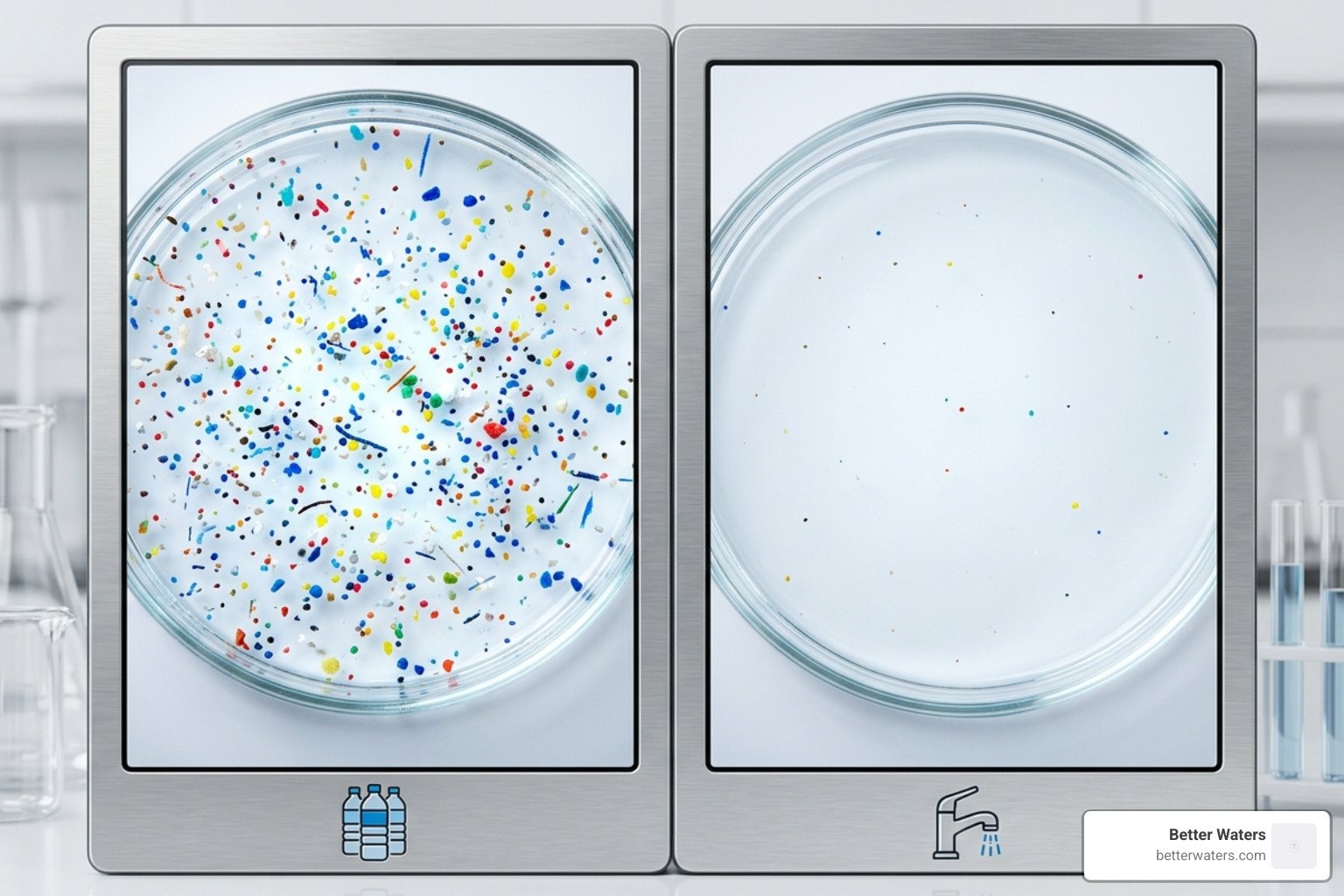
Studies have found microplastics in 83% of tap water worldwide and 93% of bottled water brands tested. One study detected up to 240,000 plastic particles per liter in bottled water, with 90% of those being nanoplastics, the smallest and hardest-to-remove category.
These aren't just environmental talking points. Microplastics have been found in human blood, lung tissue, and even breast milk. The science on long-term health effects is still emerging, but the trend is clear: reducing your exposure makes sense.
The good news? The right water filter can remove the vast majority of these particles from your drinking water, if you choose the correct technology.
Understanding the Threat: Microplastics and Nanoplastics in Your Glass
Before we dive into how to get rid of them, we need to know what we’re fighting. In water purification, size is everything.
Microplastics are defined as plastic particles smaller than 5 millimeters (about the size of a sesame seed). However, the ones that end up in our tap water are usually much, much smaller, often invisible to the naked eye. They come from two main sources:
- Primary Microplastics: These are intentionally manufactured tiny plastics, like microbeads in exfoliating soaps or industrial abrasives.
- Secondary Microplastics: These result from the breakdown of larger plastic items like water bottles, synthetic clothing (polyester and nylon), and even car tires.
Then there are nanoplastics. These are the "ninjas" of the plastic world, measuring less than 1 micrometer (1,000 nanometers). Because they are so small, they can potentially cross biological barriers in the human body. Recent research using advanced imaging found that a single liter of bottled water can contain 240,000 plastic pieces, 90% of which are nanoplastics.
How prevalent are they? In the United States, research suggests that 94% of tap water samples contain plastic fibers. While scientific research on microplastic removal in treatment facilities shows that municipal plants are often quite good at removing larger particles (often 97% to 99% of particles larger than 2 microns), the smallest fragments can still slip through the aging infrastructure or be introduced via the distribution pipes themselves.
The health concerns are real. While the EPA is still studying the long-term impacts, microplastics have been linked to gut inflammation, reproductive issues, and cellular irritation. They can also act as "magnets" for other toxins like heavy metals or PFAS, carrying them directly into our systems.
How Water Filters Remove Microplastics from Drinking Water
If you’ve ever used a spaghetti strainer, you already understand the basics of how water filters remove microplastics from drinking water. It's largely a game of "catch me if you can."
There are three primary ways a filter stops plastic:
- Mechanical Straining (Size Exclusion): The filter has holes (pores) that are smaller than the plastic particle. The water goes through; the plastic gets stuck.
- Physical Interception: Particles follow the flow of water but eventually "crash" into the filter fibers and get wedged there.
- Adsorption: This is where the particle actually sticks to the surface of the filter media (like carbon) due to chemical or electrical attraction.
To understand effectiveness, you need to look at the micron rating. An absolute micron rating means the filter is guaranteed to block 99.9% of particles of that size. A nominal rating is more of an "average" and is much less reliable for health-related filtration.
| Technology | Typical Pore Size (Microns) | Microplastic Removal | Nanoplastic Removal |
|---|---|---|---|
| Reverse Osmosis | 0.0001 | >99.9% | Excellent |
| Ultrafiltration | 0.02 | >99.9% | Good |
| Microfiltration | 0.2 | 90-100% | Limited |
| Carbon Block | 0.5 - 5.0 | Moderate | Poor |
Reverse Osmosis (RO) Filtration for Microplastics
Reverse Osmosis is widely considered the "gold standard" for home water safety. It uses a semipermeable membrane with pores so small, roughly 0.0001 microns, that they are about 10,000 times smaller than a typical microplastic fragment.
Because of this extreme "size exclusion," RO systems can effectively block not just microplastics but also the much smaller nanoplastics. When paired with a "Total Defense" style cartridge, these systems are often certified to reduce more than 99% of microplastics. If you want the most comprehensive protection possible for your home, RO is the heavy hitter.
Other Filtration Methods and Their Effectiveness
While RO is powerful, it's not the only option. Other technologies play a role in how water filters remove microplastics from drinking water:
- Ultrafiltration (0.02 microns): These systems use hollow fiber membranes. They are incredibly effective at blocking microplastics and can catch many nanoplastics without the water waste associated with RO.
- Microfiltration (0.2 micron): Research shows they can achieve 94–100% removal of common microplastic fragments.
- Carbon Block: Activated carbon is the core of most modern systems, including our XL7000. While carbon's main job is removing chlorine, lead, and bad tastes via adsorption, a high-quality, densely packed carbon block also acts as a physical barrier. However, carbon on its own (like in basic granular filters) can struggle with the smallest particles once the filter starts to saturate. This is why multi-stage filtration, combining carbon with physical membrane barriers, is the smartest approach.
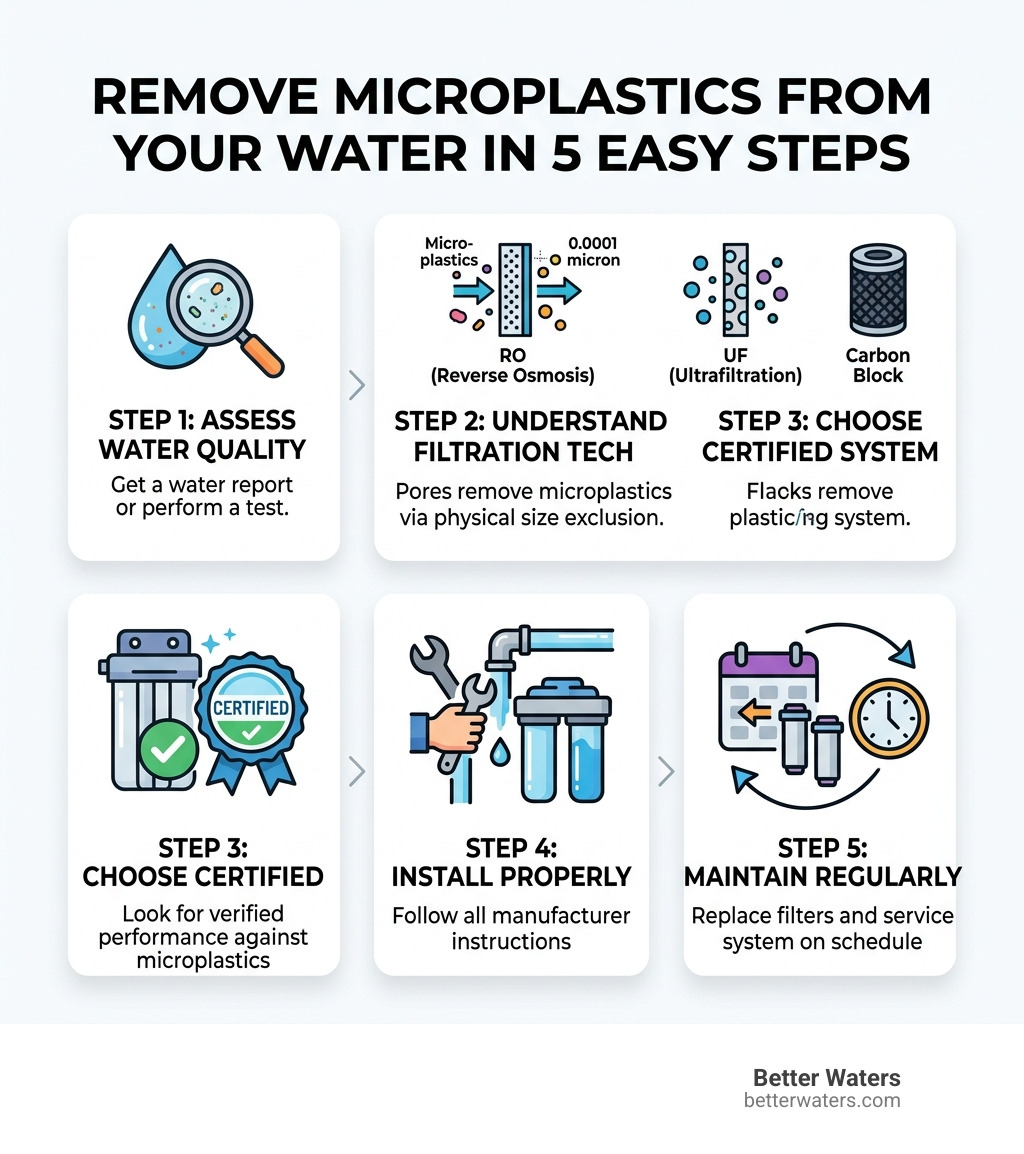
5 Easy Steps to Remove Microplastics from Your Home Water
Ready to take control of your water? Follow these five steps to ensure your family is drinking plastic-free water.
Step 1: Assess Your Water Quality
Before you buy a system, know what you're dealing with. While we know NYC tap water is generally high quality, it travels through miles of old pipes to reach your apartment.
- Check the Annual Report: Look at your DEP water quality reports.
- Professional Lab Testing: If you want to be 100% sure about what is in your specific water line, you’ll need a specialized lab test, as standard home kits don't detect microplastics.
Step 2: Understand Filtration Technologies
Don't get dazzled by fancy marketing. Look at the specs. If a filter doesn't list a micron rating, it’s probably not catching microplastics. For effective removal, you want a system that offers 0.2 micron or less (absolute rating).
Remember: A simple "charcoal" filter might make the water taste better, but it won't stop microscopic plastic fibers, such as those that can shed from synthetic clothing. You need a physical barrier.
Step 3: Choose a Certified and Effective System
Look for the NSF/ANSI 401 certification. This is a specific standard for "emerging contaminants," which includes microplastics. To earn this, a filter must prove it can reduce microplastics (sized 0.5 to 1 micrometer) by at least 85%.
Our XL7000 Water Filtration System is a perfect example of a professional-grade solution. It uses advanced multi-stage technology developed by 3M to provide bottled-quality water directly from your tap. It’s not just about taste; it’s about the peace of mind that comes with NSF-certified performance.
Step 4: Ensure Proper Installation
For the best results, we always recommend a Point-of-Use (POU) device. These are installed under your sink, right where you get your drinking and cooking water. This ensures that any plastic particles potentially picked up in your building's internal plumbing are caught at the very last second.
The XL7000 is designed for easy installation in homes and offices across NYC. Because it uses a single, high-capacity cartridge, you don't have to deal with a tangled mess of tubes or multiple housings.
Step 5: Maintain Your Filter System
A filter is only as good as its last maintenance check. Over time, the pores in a membrane can become "blinded" (clogged) with the very plastic particles they are trying to stop.
- Follow the Schedule: Most high-quality filters need replacing every 6–12 months.
- Watch the Capacity: The XL7000 has a massive 6000-gallon capacity, which is significantly higher than standard pitcher filters (which often last only 40 gallons!).
- Don't Overextend: Research shows that while some filters work up to 125% of their rated capacity, the risk of "breakthrough," where trapped particles are forced through the filter, increases as the filter fills up.
Comparing Filtration Technologies for Microplastic Reduction
When we look at the scientific study on POU device effectiveness, the data is clear: not all filters are created equal.
- The Winners: Systems with 0.2 µm microfilters achieved 90-100% removal of common plastic fragments. Reverse Osmosis systems performed even better, often reaching 99.9% removal across all particle sizes.
- The Losers: Simple Granular Activated Carbon (GAC) and Ion Exchange (IX) pitchers performed poorly. In some tests, the "effluent" (water coming out) actually had more plastic than the water going in. This happens because the loose carbon granules can trap particles and then release them all at once in a "slug" when the water pressure changes.
This is why we focus on carbon block technology in the XL7000. Unlike loose granules, a solid carbon block is compressed into a dense form that provides both chemical adsorption and physical filtration. It’s a much more reliable "wall" against contaminants.
Frequently Asked Questions (FAQ)
Can you remove microplastics by boiling water?
No. This is a common myth. Boiling water is great for killing bacteria and viruses, but microplastics are physical particles (often made of heat-resistant polymers like polypropylene). Boiling water might actually increase the concentration of microplastics because some of the water evaporates, leaving the plastic behind. You need a physical filter to remove them.
What does NSF/ANSI 401 certification mean?
This is the gold standard for "new" contaminants. While older standards (like NSF 42 and 53) focus on taste and lead, NSF 401 specifically tests for things like pharmaceuticals, pesticides, and microplastics. If a filter is certified under this standard for particulate reduction (Class I), it has been independently verified to block particles as small as 0.2 micron.
Conclusion
We live in a plastic world, but your drinking water doesn't have to be part of the problem. Understanding how water filters remove microplastics from drinking water empowers you to make the right choice for your home or office.
By choosing a high-quality, multi-stage system like the Better Waters XL7000, you’re getting more than just a filter. You’re getting a professional-grade, NSF-certified barrier that handles 6000 gallons of water with a 2.5 GPM flow rate, plenty for a busy NYC kitchen. It’s the practical, advanced implementation of carbon and physical filtration that your family deserves.
Don't settle for "good enough" when it comes to microscopic contaminants. Learn more at the Better Waters Knowledge Base and take the first step toward truly clean, plastic-free water today.
Share:
No Drill No Problem: Easy Water Filtration for Tenants
How to Understand Carbon Water Filtration Works