
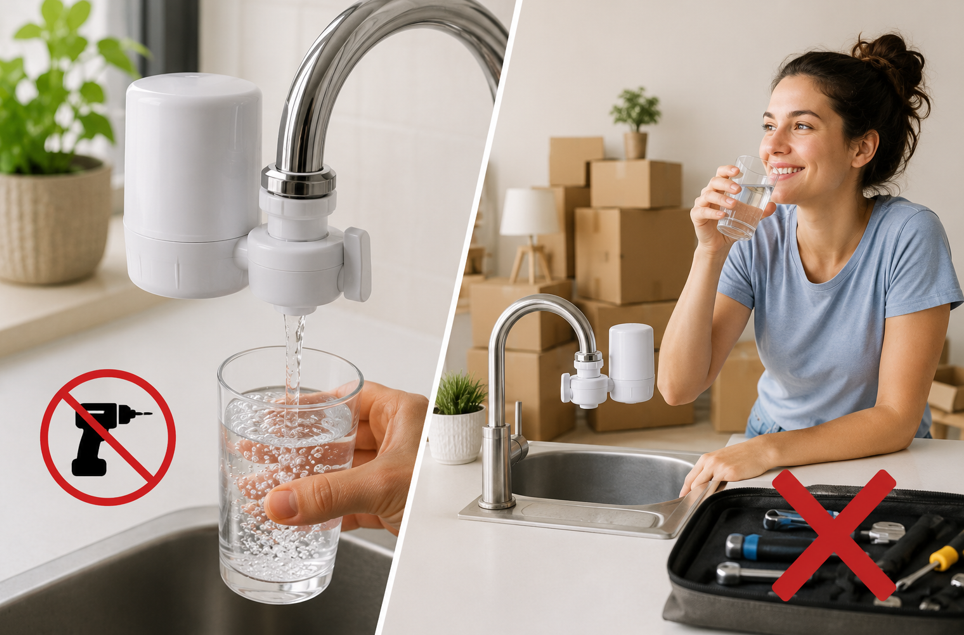
Clean Water in Your Rental: No Holes Required

Installing a water filter without drilling is easier than most renters think. You don't need a plumber, special tools, or permission to modify your kitchen. Several filter types connect directly to your existing cold water line or faucet: no countertop holes, no permanent changes, no lost security deposit.
Quick answer, your main no-drill options:
| Filter Type | How It Connects | Drilling Required? |
|---|---|---|
| Direct-connect under-sink | Taps into cold water line via T-valve | No |
| Faucet-mounted | Screws onto existing faucet spout | No |
| Countertop RO | Connects via diverter valve to faucet | No |
| Pitcher/gravity filter | Standalone, no plumbing needed | No |
Direct-connect under-sink systems are the standout choice for most renters. They sit hidden inside the cabinet, deliver filtered water straight through your existing faucet, and can be removed in minutes when you move out.
The concern is real. Tap water in many homes contains chlorine, lead, PFAS, and other contaminants you can't see or taste. But if you rent, the usual solution (drilling a hole for a dedicated filter faucet) isn't always an option.
The good news? Modern filtration technology has caught up. Systems like the Better Waters XL7000 use advanced multi-stage carbon filtration to remove the contaminants that matter most, without touching your countertop or voiding your lease.
In this guide, we'll walk through every no-drill option available in April 2026, how to install them, and what to look for in performance and certification.
Why choose a water filter without drilling?
When you live in a city like New York, space and lease agreements are two real concerns. Most standard water filtration systems require a dedicated faucet, which means drilling a hole through your granite, marble, or stainless steel countertop. For a tenant, that hole is a one-way ticket to losing a security deposit.
Choosing a water filter without drilling is about more than just avoiding damage; it's about maintaining the integrity of your home's plumbing while ensuring your health. There are 6 great reasons to filter your tap water, ranging from removing disinfectant byproducts like chlorine to eliminating heavy metals like lead that can leach from older NYC pipes.
The beauty of no-drill systems lies in their reversibility. If you decide to move from your West 26th Street apartment to a new spot in Brooklyn, you simply disconnect the system, reconnect the original hose, and take your filter with you.
Popular No-Drill Filtration Solutions for Tenants
In April 2026, the market for tenant-friendly filtration is diverse. However, not all "no-drill" options are created equal. Let's look at the most common types and why one specific category reigns supreme for the modern home.

Faucet-Mounted Filters
These are the small canisters that snap onto the end of your kitchen faucet. While they are incredibly easy to install, they have significant drawbacks. They are often considered an eyesore, they can interfere with pull-out sprayers, and because of their small size, the filtration media is limited. You'll find yourself replacing expensive tiny cartridges every few weeks.
Countertop Filters and RO Systems
Countertop Reverse Osmosis (RO) units sit on your counter and usually connect to your faucet via a diverter valve. While they offer high-level purification, they eat up valuable "Manhattan-sized" counter space. Some also require manual refilling of a water tank, which can become a tedious daily chore.
Direct-Connect Under-Sink Systems: The Ideal Renter Solution
This is where the water filter without drilling truly shines. Unlike traditional systems that need an auxiliary faucet, a direct-connect system like the XL7000 Water Filtration System installs underneath the sink and intercepts the cold water line. It sends 100% of the cold water through the filter and out of your existing kitchen faucet.
Benefits of Direct-Connect Under-Sink Systems
- Utilizes Existing Faucet: No need to drill a hole for a second tap.
- Space-Saving: Everything is tucked away inside the cabinet, keeping your countertops clutter-free.
- High Flow Rate: Modern systems can maintain a flow of up to 2.5 gallons per minute (GPM), meaning you won't be waiting forever to fill a pot of water for pasta.
- Comprehensive Filtration: These systems use larger, more powerful cartridges that can handle thousands of gallons before needing a swap.
If you're still on the fence, check out these 6 reasons to install an under-sink water filter to see how they outperform pitchers and faucet-mounts.
Step-by-Step: Installing an Under-Sink water filter without drilling
You don't need to be a DIY expert to handle this. For most of our customers, an installation takes 30–45 minutes. The proce
Share:
Stop Buying Bottled: A Step-by-Step Under Counter Water Filter Installation Guide
How to Remove Microplastics from Water in 5 Easy Steps