
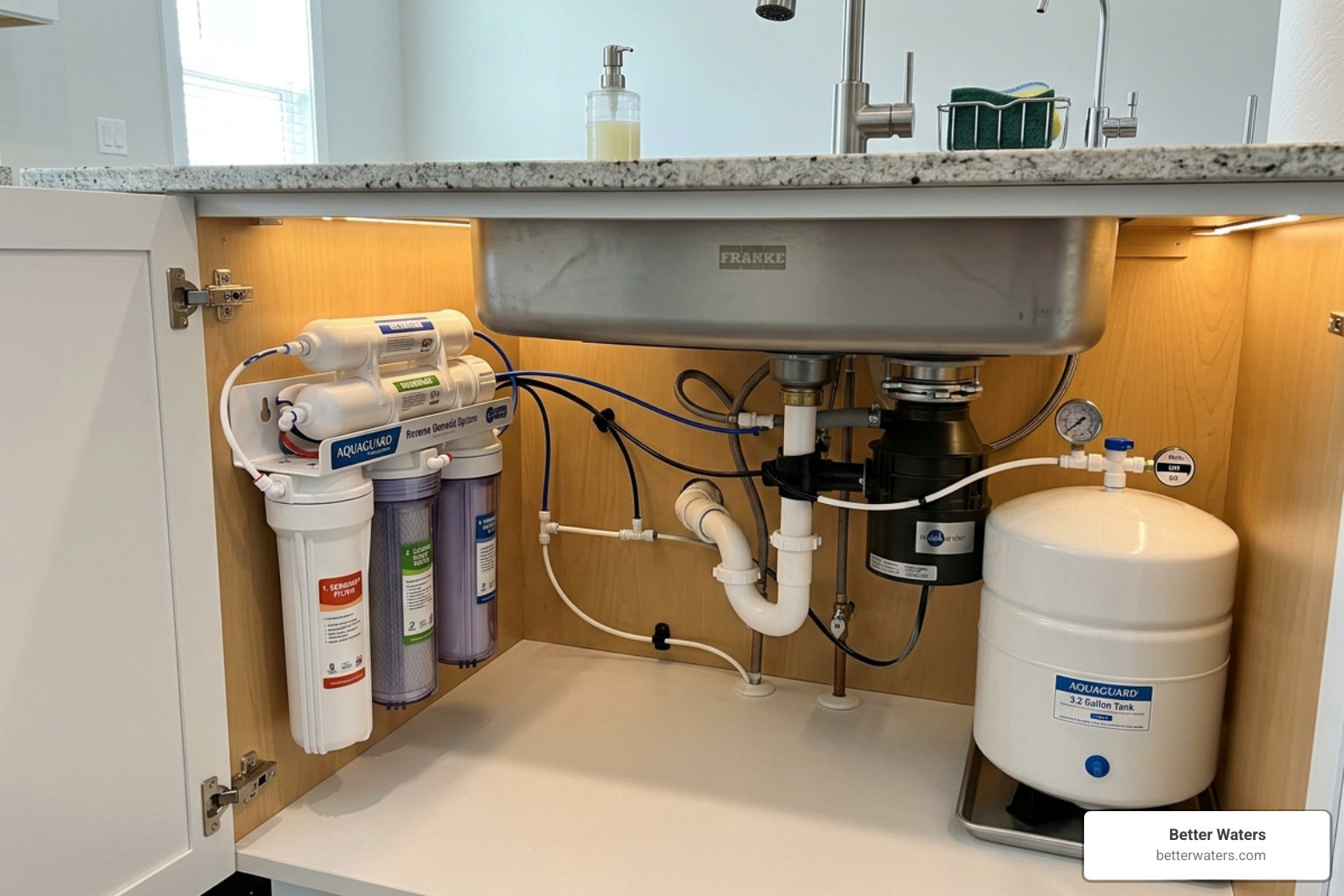
Clean Water Starts With Knowing When to Change Your Filters
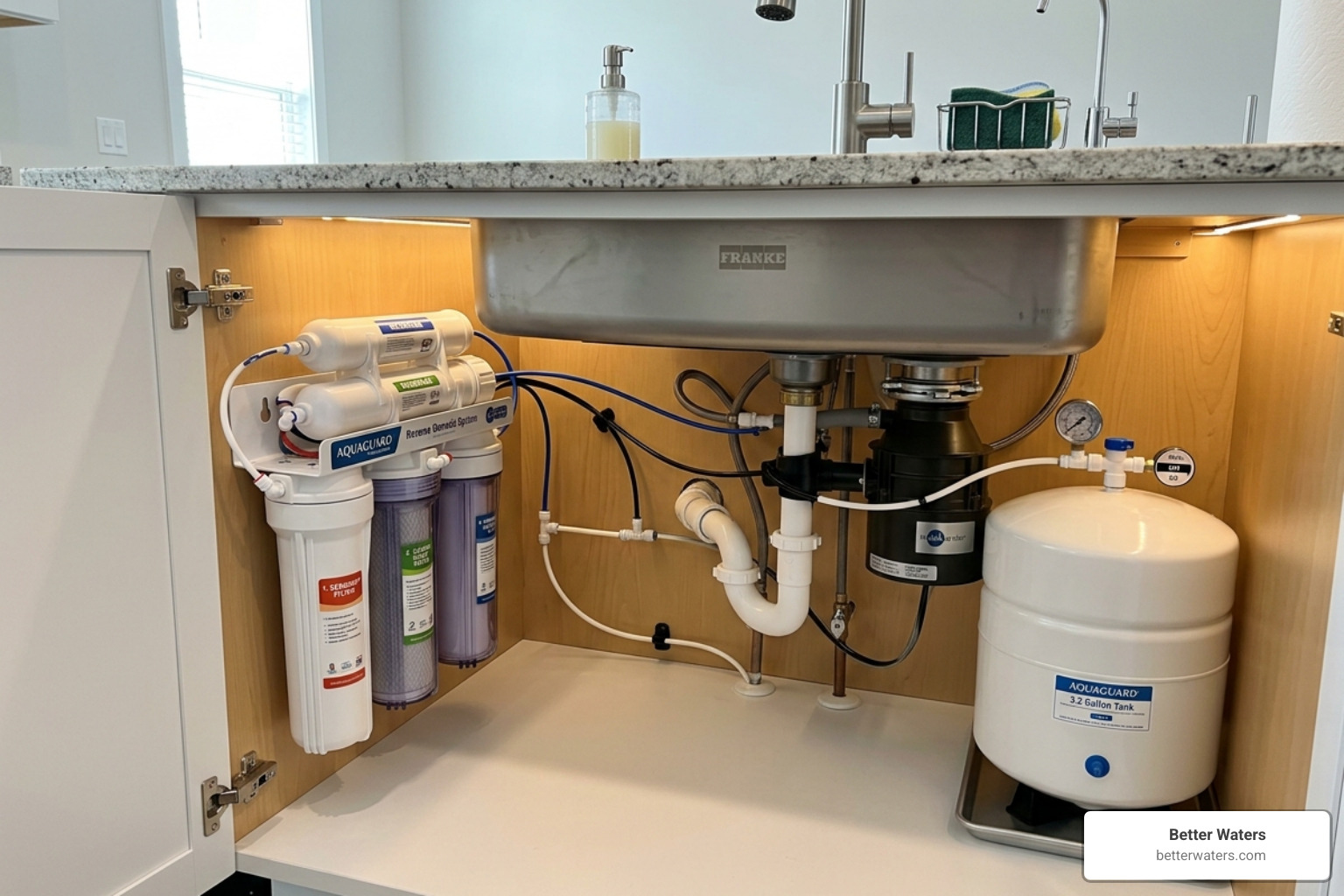
How long does a reverse osmosis filter last is one of the most important questions any RO system owner should know the answer to. The short answer: it depends on the filter stage.
| Filter Stage | Typical Lifespan |
|---|---|
| Sediment pre-filter | 6-12 months |
| Carbon pre-filter | 6-12 months |
| RO membrane | 2-5 years |
| Post-carbon (polishing) filter | 12 months |
| Full RO system | 10-15 years |
These are general guidelines. Your actual replacement schedule may be shorter or longer depending on your water quality, household size, and how well you maintain the system.
Here's why this matters: every filter stage in an RO system protects the one after it. When a sediment or carbon pre-filter clogs up, the RO membrane takes the hit. A fouled membrane means lower water quality and a shorter system life overall.
The good news? With a basic maintenance routine, a well-built RO system can deliver clean, contaminant-free water for 10 to 15 years. That's a strong return on investment, especially compared to spending $500 to $1,200 a year on bottled water.
This guide breaks down every filter stage, what shortens their life, and exactly what to watch for so you always know when it's time to act.
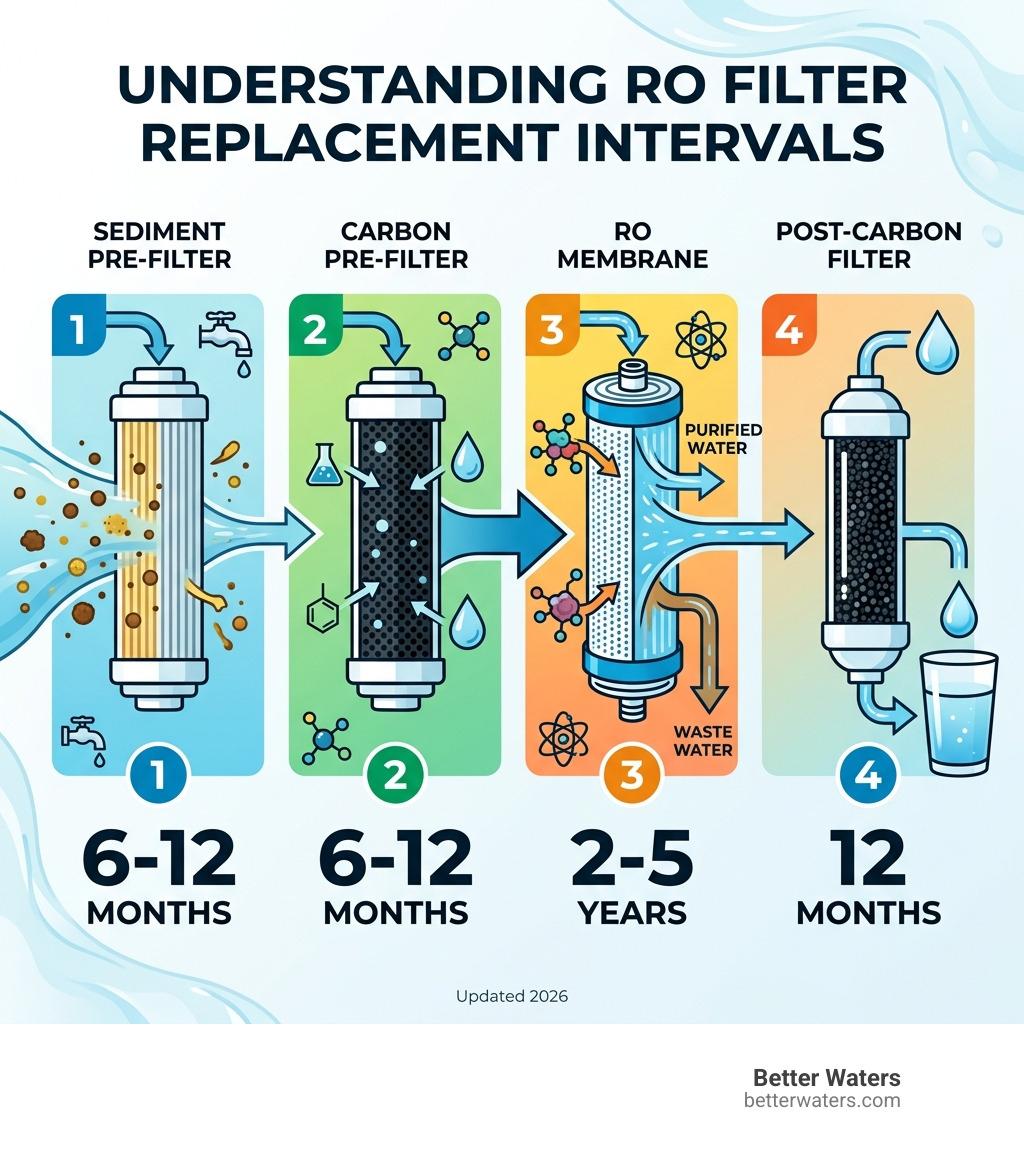
How Long Does a Filter in a Reverse Osmosis System Last?
Understanding the timeline for your reverse osmosis system is the first step toward ensuring your family always has access to pristine drinking water. While the "system" as a whole is a long-term investment, the individual cartridges inside are hardworking components that eventually wear out.
Selecting R/O as a water technology is no doubt driven by its capability of removing up to 99% of dissolved solids, heavy metals, and chlorine. However, that efficiency relies entirely on the integrity of the filters.
| Component Type | Estimated Lifespan | Primary Function |
|---|---|---|
| Sediment Pre-filter | 6–12 Months | Removes dirt, rust, and silt |
| Carbon Pre-filter | 6–12 Months | Removes chlorine and VOCs |
| RO Membrane | 2–5 Years | Rejects microscopic contaminants |
| Polishing Filter | 12 Months | Final taste and odor "polish" |
| Storage Tank | 10–15 Years | Holds purified water under pressure |
For a deeper dive into these timelines, you can explore How Long Do Reverse Osmosis Filters Last? A Comprehensive Guide - Irvingdiner, which highlights how these stages work in tandem to protect your health.
Typical Lifespan of Individual Components
To manage your system effectively, we need to look at each stage as a specialist with its own "retirement" date.
- Sediment Filters (6–12 Months): Think of this as the frontline soldier. It catches the "big stuff", sand, grit, and pipe scale. In older buildings with aging infrastructure, these might need changing closer to the 6-month mark to prevent the rest of the system from clogging.
- Carbon Pre-filters (12 Months): These are vital for protecting the delicate RO membrane. Their main job is to neutralize chlorine. If you let a carbon filter go too long, chlorine will "leak" through and chemically eat holes in your RO membrane, which is a much more expensive part to replace.
- RO Membrane (2–5 Years): This is the heart of the system. If you change your pre-filters on time, this semi-permeable membrane can last up to five years. It handles the heavy lifting, removing lead, arsenic, and nitrates.
- Post-carbon Filters (12 Months): Also known as a GAC (Granular Activated Carbon) polishing filter, this sits between the storage tank and your faucet. It ensures the water doesn't pick up a "flat" or metallic taste from the storage tank.
How long does a reverse osmosis filter last on well water?
While most people rely on municipal water, those using private wells face a different set of challenges. Well water often contains higher levels of sediment, iron, and minerals that can significantly shorten the life of your filters.
According to research from How long do reverse osmosis filters last? - Global Garden, well water users should establish a 3-month inspection cycle for their sediment pre-filters. If you notice a heavy "rust" color or a significant drop in water pressure after just 90 days, you'll need to replace those pre-filters more frequently to prevent membrane fouling. High iron content is particularly aggressive; it can create a "slime" or scale that suffocates the RO membrane's pores.
Factors Influencing RO Membrane and Filter Lifespan
Not all water is created equal. Several environmental and usage factors dictate exactly how long does a reverse osmosis filter last in your specific home or office.
- TDS Levels: Total Dissolved Solids (TDS) represent the concentration of dissolved organic and inorganic substances in your water. The higher the TDS in your "feed" water, the harder the membrane has to work to reject those particles.
- Water Hardness: Calcium and magnesium (hardness) can create scale buildup. In areas with very hard water, the RO membrane can become "blinded" by mineral deposits, reducing its lifespan.
- Usage Volume: A large family of six using the RO system for drinking, cooking, and the ice maker will exhaust filters much faster than a single professional living in a studio apartment.
- Chlorine Impact: As mentioned earlier, chlorine is the "kryptonite" of RO membranes. If your municipal water has high chlorine spikes, your carbon pre-filters will reach their adsorption limit sooner.
For more on selecting the right setup for your specific water profile, check out our guide on Choosing A Water Filter.
Impact of Water Quality on How Long a Reverse Osmosis Filter Lasts
Water quality is the primary "wear and tear" factor. When we talk about "fouling," we are referring to the accumulation of unwanted material on the membrane surface. This can be biological (bacteria), chemical (scale), or physical (sediment).
Neglecting your filter schedule doesn't just result in "less clean" water; it can lead to system malfunctions. Clogged filters cause the system to run constantly to fill the tank, which wastes thousands of gallons of water and puts unnecessary stress on the automatic shut-off valves. Ensuring your system meets NSF Certification standards is a great way to guarantee the components are rated to handle these stressors effectively.
The Role of Maintenance in System Longevity
A little TLC goes a long way. We've seen well-maintained RO systems last 15 years or more, while neglected ones might need a full replacement in five.
- Sanitization: Once a year (usually during a filter change), you should sanitize the system. A simple solution of hydrogen peroxide can be used to clean the filter housings and the storage tank to prevent biofilm growth.
- System Flushing: Some modern systems have an auto-flush feature. If yours doesn't, manually flushing the membrane for a few minutes every few weeks can help clear away accumulated "concentrate" from the membrane surface.
- O-ring Lubrication: Every time you open a filter housing, inspect the O-rings. Using a tiny bit of food-grade silicone grease ensures a watertight seal and prevents leaks that could damage your cabinetry.
For a detailed walkthrough, refer to this Step-by-Step Guide to Reverse Osmosis System Maintenance.
Signs It's Time for a Replacement
You don't always have to wait for the calendar to tell you it's time for a change. Your system will often "talk" to you through subtle performance changes.
- Decreased Water Flow: If it takes forever to fill a glass of water, your pre-filters or the membrane are likely clogged.
- Changes in Taste or Odor: If the water starts to taste "chlorine-y" or develops a "swampy" smell, your carbon filters have reached their saturation point.
- Cloudy Water: This is often a sign of air in the system or, more seriously, a ruptured membrane allowing "raw" water through.
- Noisy Drain: If you hear constant gurgling in your sink drain, the system may be struggling to shut off because a clogged filter is preventing the tank from reaching full pressure.
Monitoring Performance with a TDS Meter
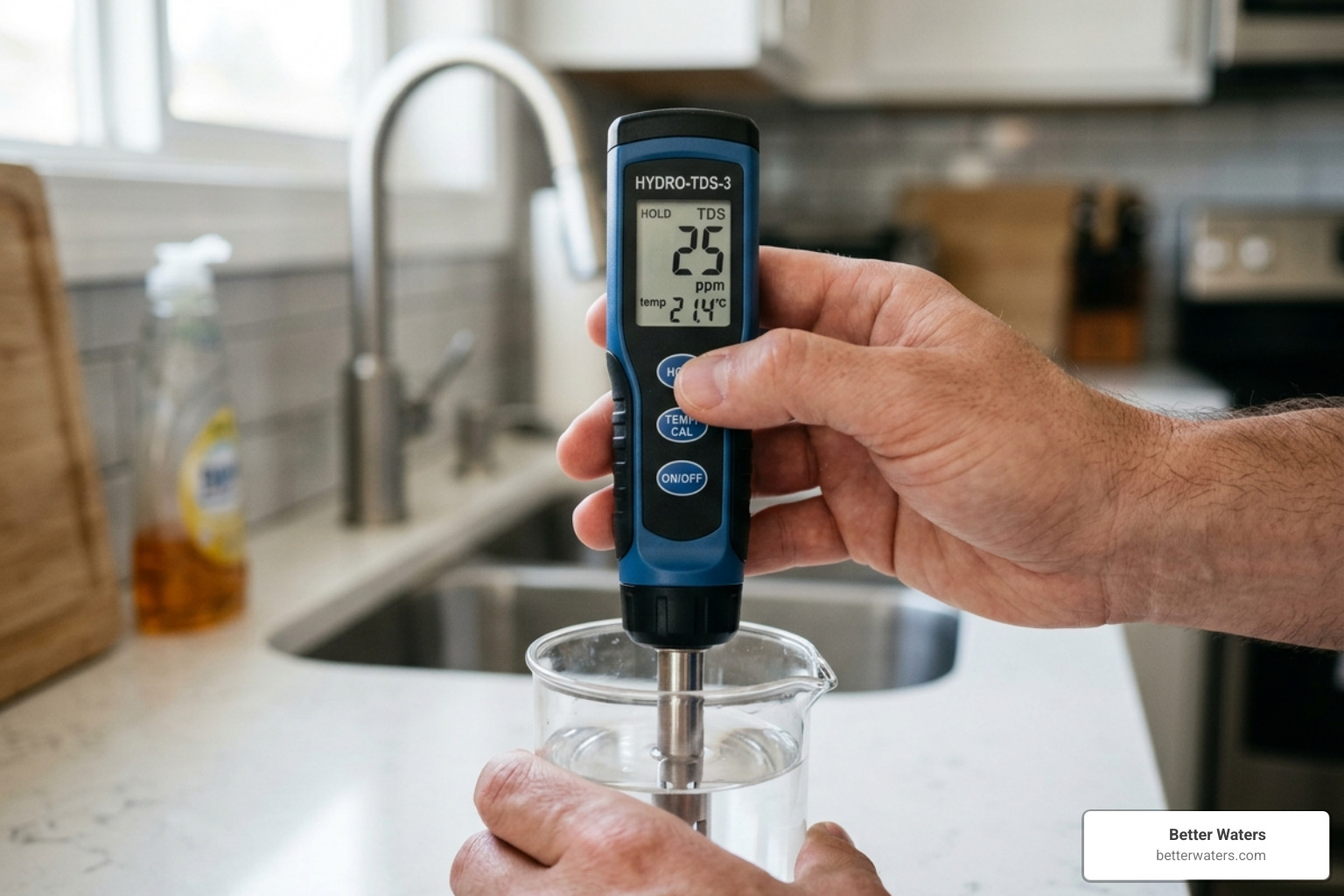
The most scientific way to know how long does a reverse osmosis system last is to use a TDS meter. This inexpensive tool measures the conductivity of the water to estimate the dissolved solids.
To test your membrane:
- Measure the TDS of your tap water (e.g., 200 ppm).
- Measure the TDS of your RO water (e.g., 10 ppm).
- Calculate the "Rejection Rate." In this case, it's 95%.
A healthy RO membrane should reject 90% or more of the incoming TDS. If your tap water is 200 ppm and your RO water climbs above 50 ppm, your membrane has likely failed and needs immediate replacement. For a deeper understanding of water testing and what these numbers mean, read our In Depth Essay What To Understand When Choosing A Filter.
Maintenance and the XL7000 Alternative
While traditional multi-stage RO systems are incredibly effective, we know that many of our customers in New York City find the maintenance schedule, juggling four different filters with four different lifespans, to be a bit of a headache.
This is where advanced multi-stage technology like our XL7000 Water Filtration System comes into play. Instead of separate housings for sediment and carbon, the XL7000 uses a high-capacity, 3M-developed multi-stage cartridge.
Why consider the XL7000 as an alternative to traditional RO?
- Simplified Longevity: The XL7000 features a massive 6000-gallon capacity. For most households, this means changing just one cartridge once a year.
- Superior Flow: Unlike RO systems that can be slow (often 0.5 GPM), the XL7000 offers a 2.5 GPM flow rate. You get bottled-quality water instantly without a storage tank.
- NSF-Certified: It provides the same peace of mind as a high-end RO system, removing chlorine, lead, and cysts while keeping the healthy minerals in your water.
- No Waste: Traditional RO systems waste 3–4 gallons of water for every gallon purified. The XL7000 is a zero-waste system, making it the eco-friendly choice for the modern Manhattan home.
By utilizing advanced carbon filtration as its core, the XL7000 provides the same "polishing" effect of an RO system but in a much more manageable, high-performance package. Upgrade to the XL7000 Water Filtration System today for a simpler, more efficient way to enjoy pure water.
Frequently Asked Questions (FAQ)
Can I use third-party filters instead of OEM?
While third-party filters are often cheaper, we generally advise sticking with OEM (Original Equipment Manufacturer) filters. OEM filters are designed specifically for your system's pressure requirements and housing dimensions. Third-party filters may lack the same NSF certifications, potentially leading to bypass (where water goes around the filter rather than through it) or even leaks that can damage your kitchen.
How much does annual RO maintenance cost?
On average, homeowners spend between $50 and $100 annually on pre- and post-filters. Every few years, when the RO membrane needs replacing, you might see an additional $40 to $80 added to that year's budget. Compared to the cost of purchasing bottled water for a family in New York, the system usually pays for itself within the first 12 to 18 months.
When should I replace the entire RO system?
Even with perfect maintenance, mechanical parts eventually wear out. We recommend considering a full system replacement after 10 to 15 years. By this point, the plastic housings can become brittle, and the internal valves may become prone to failure. Additionally, water filtration technology evolves quickly, upgrading to a newer system like the XL7000 Water Filtration System can provide better flow rates and easier maintenance than trying to keep a 20-year-old RO unit on "life support."
Conclusion
Knowing how long does a reverse osmosis filter last is the key to protecting both your health and your home. By sticking to a 6-to-12-month schedule for pre-filters and monitoring your membrane every few years with a TDS meter, you can enjoy crisp, clean water for over a decade.
At Better Waters, we believe clean water shouldn't be a chore. Whether you choose to maintain a traditional RO system or upgrade to the streamlined efficiency of the XL7000 Water Filtration System, we are here to support our neighbors with the best technology and expert advice.
Proactive care is the difference between a system that fails and one that flourishes. Set those calendar reminders, keep an eye on your water flow, and never hesitate to reach out to us for help keeping your water at its best.
Share:
Why Your NYC Home Needs Pro Grade Filtration NY Style
Cost Effective Filter Replacement Options That Actually Work