
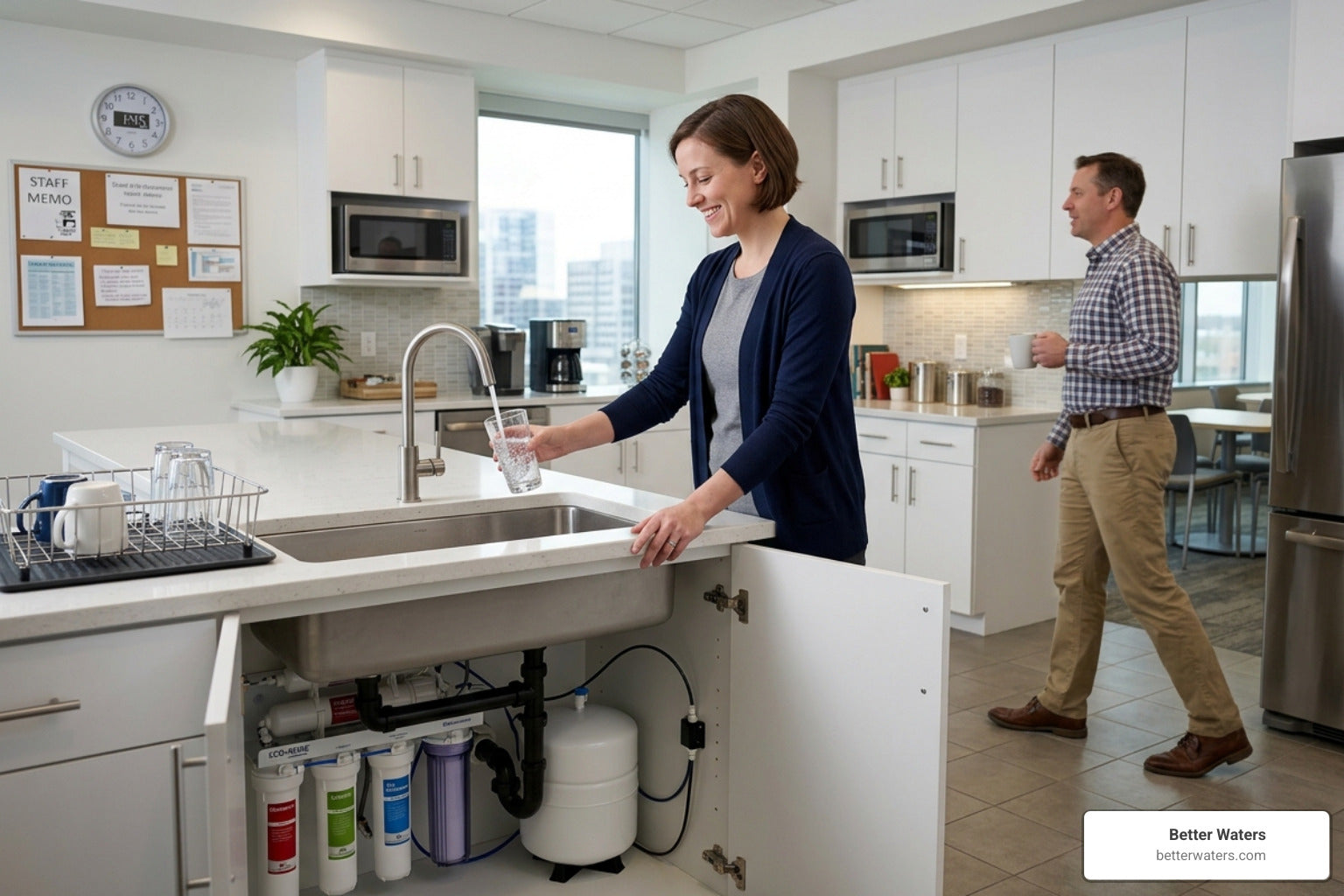
Your Office Drinking Water Is Probably Worse Than You Think
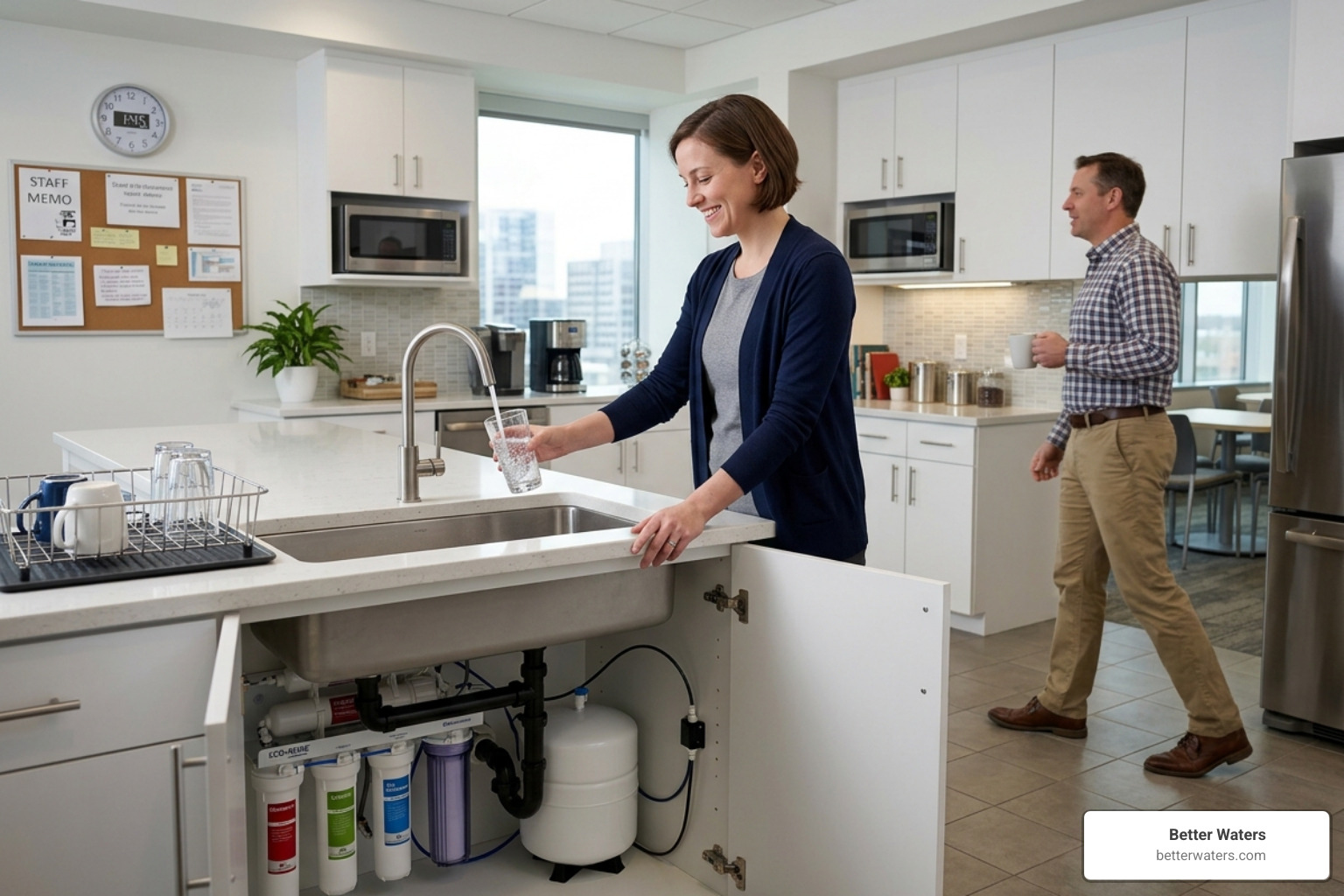
A workplace water filtration system is a direct-connect, plumbed-in solution that filters tap water at the point of use, giving employees clean, great tasting water without the cost or waste of bottled delivery.
Here's what you need to know at a glance:
| Question | Quick Answer |
|---|---|
| What does it do? | Removes contaminants like lead, PFAS, chlorine, and microplastics from tap water |
| Who needs one? | Any office with employees relying on bottled water or unfiltered tap |
| What are the main types? | Countertop, freestanding, and point-of-use (POU) systems |
| How much can you save? | The more employees you have, the more you'll save compared to bottled water delivery |
| How quickly can it be installed? | Most systems install in under an hour |
| What certifications matter? | NSF/ANSI 42, 53, 58, and 401 |
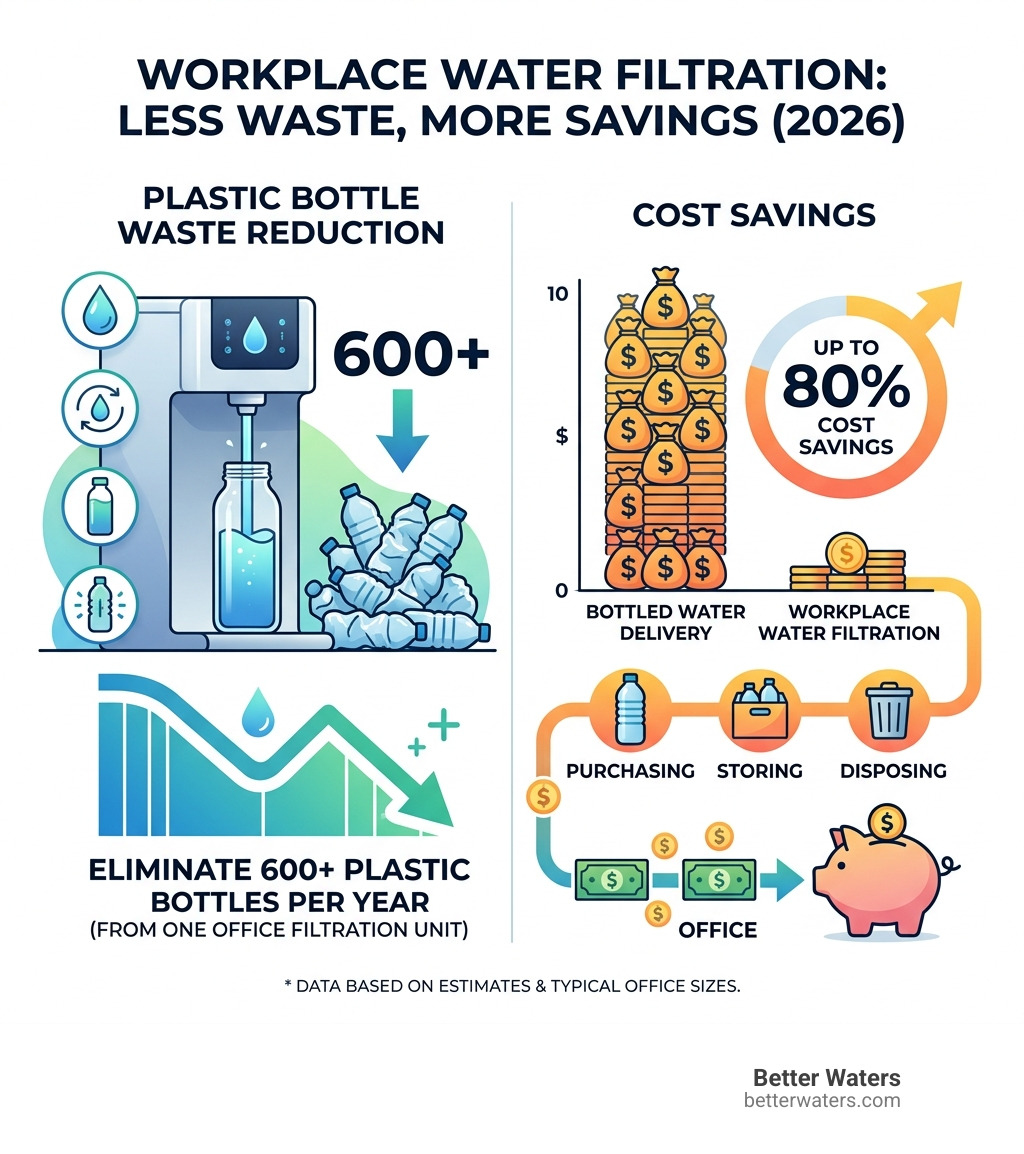
Think about how many plastic bottles pass through your office every week. Globally, 16,667 plastic bottles are discarded every single second, a statistic highlighted in reports on global plastic pollution. A single bottleless filtration unit can eliminate typically 600 of those bottles per year, just from one office. Not only that: In New York City, every single bottle of water must be trucked in. The increased traffic and air pollution caused by the delivery of bottled water alone, whether to retail or offices, is a staggering statistic.
But sustainability is only part of the story.
Tap water quality varies widely depending on your location. Contaminants like lead, chlorine byproducts, PFAS, and microplastics can be present even in municipal water supplies that technically meet regulatory standards. Your employees are drinking that water, or avoiding it altogether and reaching for plastic bottles instead.
Neither outcome is good for your team or your budget.
This guide walks you through everything you need to choose the right workplace water filtration system in 2026, from filtration technologies and certifications to cost savings, installation, and the best fit for your office size.
Evaluating Key Water Filtration Technologies for Optimal Workplace Hydration in 2026
When you start looking for a workplace water filtration system, the sheer number of acronyms can be overwhelming. RO? UF? POU? It sounds more like a bowl of alphabet soup than a hydration strategy. In April 2026, the market has shifted toward high-efficiency, multi-stage systems that prioritize flow rate and taste.
To make the right choice for your New York City office, you first need to understand the delivery method. Point-of-use (POU) systems are the gold standard for modern workplaces. Unlike bottled coolers that require heavy lifting and storage space, POU systems connect directly to your building's water line. These can be configured as countertop units for tight breakrooms, freestanding towers for high-traffic hallways, or discreet under-sink systems that provide "bottled-quality" water directly from a dedicated tap or dispenser.
If you are still on the fence about whether your building's water is "fine as it is," check out these 6 great reasons to filter your tap water.
| Feature | Reverse Osmosis (RO) | Ultrafiltration (UF) | Advanced Carbon Filtration |
|---|---|---|---|
| Contaminant Removal | 99.9% (including TDS) | 99% (retains minerals) | High (Lead, PFAS, Chlorine) |
| Water Waste | High (creates brine) | Zero | Zero |
| Flow Rate | Low (needs a tank) | Low | High (2.5+ GPM) |
| Maintenance | Complex | Moderate | Simple (Cartridge swap) |
| Office Suitability | Specialized | Small Teams | Best for High Traffic |
Why Reverse Osmosis (RO) Systems Are Often Not Ideal for Office Use
Reverse Osmosis is often touted as the "ultimate" purification method because it removes 99.9% of everything, including Total Dissolved Solids (TDS). While that sounds great on paper, it's often overkill for an office environment in New York City.
First, RO systems are notoriously slow. They typically require a storage tank because the water trickles through the membrane so slowly. In a busy office, the tank can run dry during the morning coffee rush, leaving the last few people in line with a pathetic drizzle. Second, RO systems produce "wastewater" or brine. For every gallon of pure water produced, traditional RO systems can waste several gallons down the drain. Finally, RO requires a dedicated drain line, which complicates installation in many commercial office layouts. Unless your local water quality report shows extremely high levels of dissolved solids (and in New York City it definitely will not), the disadvantages of RO, namely slowness, waste and expense, usually outweigh any seeming benefits.
Understanding the Limitations of Ultrafiltration (UF) for Comprehensive Office Water Quality
Ultrafiltration (UF) is a "middle ground" technology. It uses a hollow fiber membrane to mechanically filter out bacteria and suspended solids while allowing healthy minerals like calcium and magnesium to pass through.
The main advantage of UF is that it produces zero wastewater and doesn't require a drain. This makes it a popular choice for small office suites. However, UF has a significant weakness: it isn't as effective at removing dissolved chemicals, tastes, and odors on its own. If your NYC office water has a strong chlorine scent or a metallic tang, a basic UF system might leave employees reaching for bottled water anyway. To get the best results, UF must be paired with high-quality carbon blocks, which leads us to why advanced multi-stage carbon filtration is usually the "sweet spot" for workplace productivity.
The Business Case for Bottleless Hydration
If you are still managing a "water club" where employees take turns lifting 40-pound plastic jugs onto a cooler, it's time for an upgrade. Bottleless coolers, another name for POU filtration systems, are the future of the American workplace.
The statistics are staggering. We know that 16,667 plastic bottles are tossed every second. By switching to a filtered system, a single office can replace nearly 1,000 plastic bottles per year. In high-capacity settings, some systems are designed to replace the equivalent of tens of thousands of bottles over their lifespan.
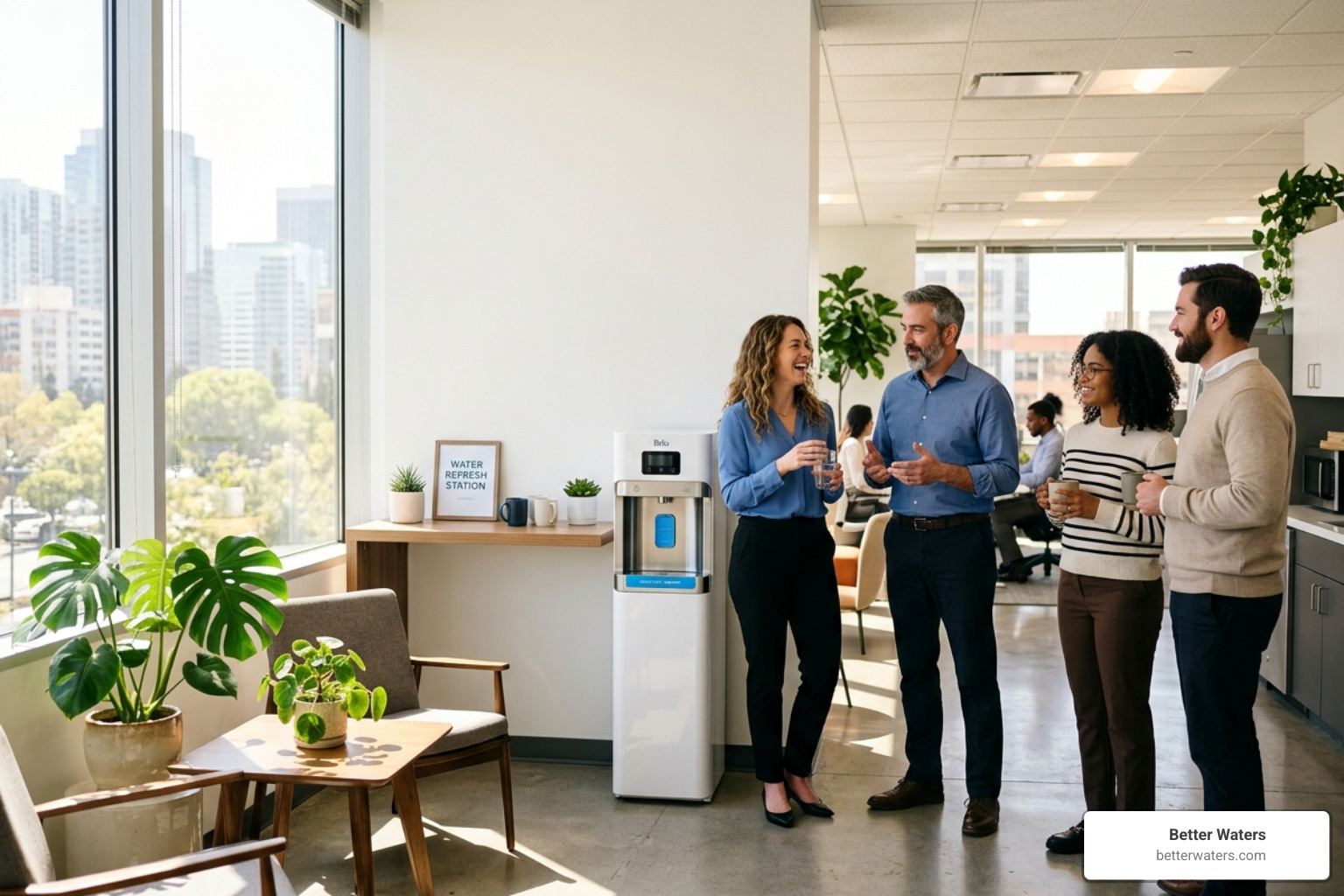
Beyond the environmental factors, bottleless systems solve three major office headaches:
- Safety: No more workers' comp claims from lifting heavy 5-gallon jugs.
- Space: You can reclaim that storage closet currently filled with empty plastic crates.
- Security: No more delivery people wandering through your secure office space every Tuesday.
Ready to see the options? Explore Better Waters Bottleless Solutions to find a fit for your floor plan.
Cost Savings and ROI of a Workplace Water Filtration System
Let's talk numbers. Many businesses find that switching to a workplace water filtration system saves them up to 80% on their annual drinking water costs compared to bottled delivery.
When you pay for bottled water, you aren't just paying for water; you're paying for the plastic, the diesel for the delivery truck, the warehouse labor, and the marketing. With a POU system, you are utilizing the infrastructure you already pay for, your building's water line.
While a professional-grade under-sink filter or freestanding dispenser has an upfront cost, the Return on Investment (ROI) is usually realized within the first year. Maintenance is predictable, typically involving a simple filter change once or twice a year. For more on the financial and practical benefits, read our guide on 6 reasons to install an under-sink water filter.
Environmental Advantages and Sustainability
In 2026, corporate social responsibility (CSR) isn't just a buzzword; it's a requirement for attracting top talent. Employees, especially younger generations, want to work for companies that take sustainability seriously.
By eliminating the "plastic bottle footprint," your office significantly reduces its carbon emissions. Think about the fuel required to truck heavy water jugs across the city, only to have them picked up, washed, and refilled. A plumbed-in system is the most water-efficient and carbon-efficient way to stay hydrated. It's a tangible, visible way to show your team that your company cares about the planet.
Advanced Technology and Contaminant Removal for Office Environments
Modern commercial water systems are built to tackle "emerging contaminants" that weren't even on the radar a decade ago. This includes PFAS (the so-called "forever chemicals"), lead from aging city pipes, and microplastics.
Top-tier systems now incorporate UV-C sanitization. This technology uses ultraviolet light to continuously treat the water reservoir or the dispensing nozzle, killing 99.9% of bacteria and viruses without using chemicals. This is especially important in a shared office environment where dozens of hands touch the dispenser every day. To dive deeper into the science of what these filters actually catch, see this in-depth essay what to understand when choosing a filter.
Key Features to Prioritize in a Workplace Water Filtration System
When shopping for your office in NYC, don't just look at the price tag. Consider these "quality of life" features that can make or break the employee experience:
- Touchless Dispensing: In a post-pandemic world, sensor-operated "wave to dispense" technology is a huge hit for hygiene.
- High Flow Rate: No one wants to spend three minutes filling a 32-ounce sports bottle. Look for systems like the XL7000 that offer 2.5 gallons per minute (GPM).
- Hot/Cold/Sparkling Options: If you want to provide a true "amenity," look for systems that offer instant hot water for tea and sparkling water for a mid-afternoon pick-me-up.
- Leak Detection: High-end commercial units include automatic shut-off valves if a leak is detected, protecting your office floors and tech.
Verifying Certifications and Safety Standards
Don't take a manufacturer's word for it, look for independent verification. The most important certifications for a workplace water filtration system, which you can verify via the NSF International database, include:
- NSF/ANSI 42: Covers aesthetic effects (chlorine, taste, and odor).
- NSF/ANSI 53: Covers health effects (lead, PFAS, VOCs).
- NSF/ANSI 58: Specifically for Reverse Osmosis systems.
- WQA Gold Seal: Indicates the product is made from safe materials and performs as claimed.
Choosing a system with these badges ensures that the "pure" water you're promising your employees is actually pure.
Why Carbon Filtration is the Core of Modern Office Systems
If there is one "superhero" in water purification, it's activated carbon. Almost every high-quality workplace water filtration system relies on activated carbon as its primary engine.
Carbon filtration works through adsorption, where contaminants stick to the massive surface area of the carbon particles like magnets. This is particularly effective for removing chlorine, which is used by municipal plants to disinfect water but leaves a chemical taste and smell. Multi-stage systems often use a "pre-filter" to catch sediment (rust, sand) and then a high-density carbon block to "polish" the water for bottled-quality taste. If you're wondering if your specific desk setup needs this, check out do I need an under-sink water filter.
Practical Implementation of Advanced Multi-Stage Filtration with the XL7000
At Better Waters, we believe that office water should be simple, high-volume, and incredibly clean. Our XL7000 Water Filtration System is the perfect example of how advanced carbon technology outperforms traditional RO or UF setups in a busy workplace.
Developed with 3M technology, the XL7000 is a professional-grade powerhouse. While many office filters struggle to provide more than 1 GPM, the XL7000 delivers a high 2.5 GPM flow rate. It features a 6000-gallon capacity, meaning even a large office can go months without needing a cartridge change. It's an "all-in-one" solution that removes sediment and chlorine while providing that crisp, refreshing taste employees crave. Plus, the sanitary quick-change design means you can swap the filter in seconds, with no tools, no mess, and no calling a plumber. Learn more about the XL7000 Water Filtration System here.
Installation and Maintenance for High-Traffic Offices
One of the biggest myths about a workplace water filtration system is that installation is a nightmare. In reality, a professional POU connection usually takes less than 30 to 60 minutes. It involves tapping into an existing cold water line, usually under a breakroom sink, and running a small, flexible tube to the dispenser or dedicated faucet.
Maintenance is equally straightforward. In a high-traffic NYC office, we recommend:
- Quarterly Sanitization: Wiping down dispensing nozzles and drip trays.
- Filter Replacement: Depending on your team size, this usually happens every 6 to 12 months.
- System Check: Ensuring the leak detection and cooling elements are functioning at peak performance.
Scalability for Different Office Sizes
Not all offices are created equal. A startup with 5 people in a WeWork suite has different needs than a hedge fund with 100+ employees in Midtown.
- Small Teams (3-15 people): A compact countertop unit or a high-quality under-sink system like the XL7000 is perfect. It provides plenty of water without taking up valuable floor space.
- Medium Offices (15-50 people): A freestanding bottleless cooler with a 2-3 gallon cold reservoir is ideal to handle the "lunch hour rush."
- Large Offices (50-100+ people): You'll want high-capacity systems capable of filtering 200+ gallons daily. In these environments, we often recommend installing multiple "hydration stations" throughout the floor to prevent congestion.
Frequently Asked Questions about Office Water Quality
How much can an office save by switching from bottled delivery?
Most offices see a cost reduction of 60% to 80%. When you stop paying for the "logistics" of bottled water and switch to a plumbed-in workplace water filtration system, your only ongoing costs are the occasional filter replacement.
What contaminants do commercial systems effectively remove?
Professional-grade systems are designed to remove lead, chlorine, chloramines, PFAS, microplastics, cysts, and sediment. Systems with UV-C technology also neutralize bacteria and viruses, providing an extra layer of protection for shared dispensers.
What is the difference between RO and UF for workplace use, and why is carbon filtration often preferred?
RO removes everything (including minerals) but is slow and wasteful. UF is faster and wastes no water but doesn't always improve taste. Advanced carbon filtration, like that found in the XL7000, offers the best of both worlds: high flow rates, zero waste, and superior taste/odor removal by targeting the chemicals no one wants to consume.
Conclusion
Choosing the right workplace water filtration system is one of the easiest ways to improve office morale, save money, and meet your sustainability goals in 2026. Whether you are looking for a sleek freestanding dispenser or a high-capacity under-sink solution, the goal remains the same: providing your team with the healthiest, best-tasting water possible.
The Better Waters XL7000 stands at the top of its class for NYC offices. It's a professional-grade, NSF-certified, 3M-developed system that brings bottled-quality water directly to your tap with zero waste and zero hassle. Don't let your team settle for mediocre tap water or expensive, wasteful bottles.
Ready to upgrade your office hydration? Check out the XL7000 Water Filtration System and see why it's the preferred choice for modern workplaces.
Share:
Don't Lose Your Deposit with These Renter Friendly Water Filters
NYC Tap Water vs Bottled Taste Test