
Why a Sediment Filter Is the First Line of Defense for Clean Water
Sediment filters are mechanical filtration devices that remove physical particles, like sand, silt, rust, scale, and debris, from your water supply before they reach your taps, appliances, or downstream filters.

If you're looking for a quick answer, here are the top sediment filter picks to consider:
| Filter Type | Best For | Micron Rating | Avg. Price |
|---|---|---|---|
| Spin-down (reusable) | Whole house pre-filtration | 40-50 micron | $70-$135 |
| Pleated cartridge | Whole house, high flow | 5-20 micron | $15-$35 |
| Multi-layer polypropylene | Under-sink, RO pre-filter | 1-25 micron | $5-$20 |
| String-wound cartridge | Well water, high sediment | 5-50 micron | $8-$25 |
Here's the thing: dirty water doesn't just look bad. Sediment quietly wears down your pipes, clogs faucet aerators, shortens the life of your appliances, and exhausts your other filters far too quickly.
Even municipal water treated to meet EPA standards can carry rust flakes from aging pipes and debris stirred up during main breaks. Well water? Often even worse.
If you've ever turned on a tap and noticed cloudy water, gritty residue, or a drop in water pressure throughout your home, sediment is likely the culprit.
A quality sediment filter doesn't just clean your water, it protects everything downstream, from your reverse osmosis membrane to your water heater. For a comprehensive solution that handles both sediment and chemical contaminants, the XL7000 Water Filtration System is an industry-leading choice.
Understanding the Role of a Sediment Filter in Your Home
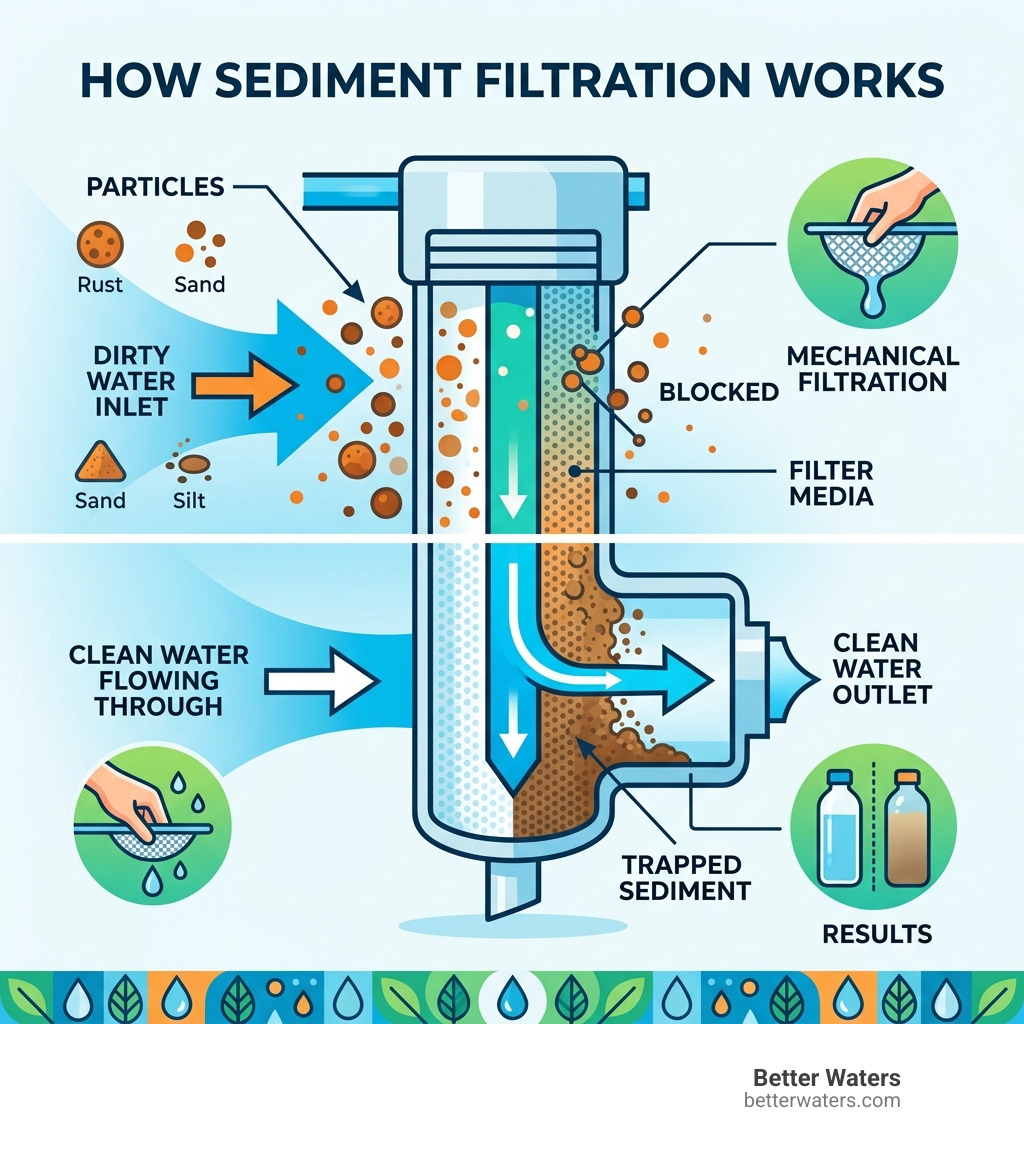
When we talk about water quality in cities like New York, we often focus on chemicals or taste. However, the physical "stuff" floating in your water, technically known as suspended solids, is often the most immediate threat to your plumbing. A sediment filter acts as a giant strainer. It uses mechanical filtration to physically block particles that are too large to pass through its pores.
Whether you are dealing with city water or well water, the challenges remain similar but the sources differ. In NYC, our municipal water travels through miles of aging infrastructure. It is common for rust flakes from old iron pipes or scale from water mains to break loose and head straight for your kitchen faucet. If you are using well water, you might be dealing with sand, silt, clay, or organic matter pulled directly from the ground.
According to Drinking Water Treatment: Sediment Filtration, these filters are designed to handle insoluble particles. This means they trap things that don't dissolve, like grit and dirt. However, they aren't a "cure-all." They won't remove dissolved minerals (like calcium that causes hard water) or chemicals like chlorine. That is why we often see them paired with more advanced systems. Understanding these 4 Common Issues with Tap Water helps clarify why a physical barrier is your first necessary step.

Choosing the Right Micron Rating for Your Sediment Filter
One of the most confusing parts of buying a sediment filter is the "micron rating." A micron is a unit of measurement equal to one-millionth of a meter. To give you some perspective, a human hair is about 75 microns wide.
- 5-Micron Filters: These are excellent for fine sediment. They trap particles that are invisible to the naked eye, such as fine silt or tiny rust flakes. These are often used as pre-filters for under-sink systems or RO units.
- 50-Micron Filters: These are "coarse" filters. They are designed to catch large debris like sand or large pieces of scale. These are typically used as "spin-down" filters right where the water enters the house.
- Nominal vs. Absolute: This is a technical distinction that matters. A nominal rating means the filter traps about 85% of particles at that size. An absolute rating means it traps 99.9%. If you have very specific water quality needs, aim for absolute.
When Choosing a Water Filter, we always recommend matching the micron size to your specific problem. If you use a 5-micron filter for heavy sand, it will clog in a week. If you use a 50-micron filter for fine NYC silt, the water will still look cloudy.
How a Sediment Filter Protects Downstream Systems
Think of a sediment filter as a bodyguard for your more expensive water treatment equipment. If you have a Reverse Osmosis (RO) system, the membrane is incredibly delicate. A single piece of sand can tear it, and fine silt will "blind" the membrane, rendering it useless.
The same applies to UV purifiers. UV light needs to "see" the bacteria to kill them. If there is sediment in the water, bacteria can "hitch a ride" behind a speck of dirt, shielding them from the UV rays. This is called shadowing.
Furthermore, carbon block filters, like the high-performance ones we use in our systems, are designed to adsorb chemicals. If they get coated in mud and rust, they can't do their job. By removing the "heavy lifting" of physical dirt first, you ensure your carbon filters last their full 6000-gallon lifespan. This is Why a Point-of-Use Water Filter Just Makes Sense for Your Home; it targets the specific needs of your drinking water while protecting the technology inside. This multi-stage approach is a core component of modern systems like the Better Waters XL7000, which positions advanced carbon technology behind a robust sediment defense.
Types of Sediment Filtration Systems and Media
Not all filters are created equal. Depending on your water's "dirt profile," you might need a different physical structure to catch the debris.
| Filter Type | Mechanism | Material | Best Usage |
|---|---|---|---|
| Spin-Down | Surface / Centrifugal | 316L Stainless Steel | Large sand/grit; reusable |
| Pleated | Surface | Polyester / Cellulose | High flow rates; washable |
| String-Wound | Depth | Polypropylene / Cotton | Variable particle sizes; well water |
| Melt-Blown | Depth | Polypropylene | Fine particles; RO pre-filtration |
Surface vs. Depth Filtration
A surface filter (like pleated or spin-down) acts like a screen. It catches everything on the outside. Once that surface is covered, the water stops flowing. These are great because they often have more surface area and can be rinsed off.
A depth filter (like string-wound or melt-blown) is more like a thick sponge. It traps larger particles on the outside and finer particles as the water moves deeper into the media. These are excellent for water with a mix of different sediment sizes.
As we discuss in our In-Depth Essay: What to Understand When Choosing a Filter, the media material matters too. Polypropylene is the industry standard because it is chemically resistant and doesn't support bacterial growth, a common issue with older cellulose (paper) filters.
Top-Rated Sediment Filter Solutions for 2026
As of April 2026, the market has leaned heavily toward "smart" maintenance and high-flow efficiency. We've seen a massive surge in homeowners in areas like Massapequa and Long Island seeking whole-house protection to deal with local water main updates.
Reusable Spin-Down Filters
High-performance spin-down pre-filters have become a staple for many households. These often feature a 316L molybdenum alloy mesh (usually 50 microns). The beauty of these is the "backwash" or "flush" function. Instead of taking the filter apart, you simply turn a valve at the bottom to flush the trapped sand and grit down the drain. This is a lifesaver for homes with high sediment loads that would otherwise chew through disposable cartridges every month.
High-Flow Whole House Systems
For total home protection, high-capacity 4.5" x 20" housings remain the gold standard. These systems can support flow rates of up to 20-40 GPM (Gallons Per Minute), meaning you won't see a drop in shower pressure even when the dishwasher is running. Professional-grade systems use grooved cartridges to increase surface area, often lasting 6 months even in challenging conditions.
For residents in New York, professional services like Sediment Filtration in Massapequa, NY - Chivalry Plumbing & Heating highlight the importance of high-flow systems that can handle the volume required for modern multi-bathroom homes. These setups are often the first step before water reaches a dedicated multi-stage system like the Better Waters XL7000 for final purification.
Installation and Maintenance: Keeping Your Water Clear
One of the best things about a sediment filter is that it is generally DIY-friendly. Most "Point of Entry" (whole house) systems require some basic plumbing, but many "Point of Use" (under-sink) systems use quick-connect fittings that take minutes to install.
Key Installation Tips:
- Placement: Always install the sediment filter first. It should be the very first thing your water hits after the main shut-off valve or the pressure tank.
- Pressure Relief: Look for housings with a red pressure relief button. This makes it much easier to unscrew the housing when it's time to change the filter.
- O-Rings: When you change a filter, always inspect the rubber O-ring. Wipe it clean and apply a thin layer of food-grade silicone lubricant to prevent leaks.
Maintenance Schedule
How often should you replace it? The standard answer is every 6–12 months, but your water will tell you the truth. If you notice your water pressure dropping in the shower, or if your "clear" housing looks dark brown or black, it's time for a change. Using a transparent sump allows for a quick visual check without needing tools.
If you are wondering, "Do I Need an Under Sink Water Filter," the answer is almost always yes if you value the longevity of your kitchen appliances and the taste of your coffee. For the ultimate combination of sediment protection and chemical removal, consider the XL7000 Water Filtration System.
Frequently Asked Questions
How do I know if my sediment filter is clogged?
The most common sign is a noticeable drop in water pressure. Since the filter traps particles, those particles eventually block the path of the water. You might also notice the water returning to a cloudy or "milky" state, or see visible flecks of rust in your toilet tank.
Can a sediment filter remove bacteria or chemicals?
Generally, no. Standard sediment filters are mechanical barriers. While some "sub-micron" filters (0.2 microns) can trap some bacteria, they are not a substitute for disinfection. Similarly, they do not remove chlorine, lead, or PFAS. For that, you need a multi-stage system that includes activated carbon or reverse osmosis.
Are reusable spin-down filters better than disposable cartridges?
"Better" depends on your water. If you have large, heavy sand, a reusable spin-down filter is much more cost-effective. However, if you have very fine silt or "flour sand," a spin-down filter won't catch it, you'll need a 5-micron disposable depth filter to get the water truly clear.
Conclusion: The Ultimate Defense for Your Home's Water
At the end of the day, a sediment filter is the unsung hero of home maintenance. It protects your pipes, saves your water heater from "tank mud," and ensures that your drinking water is clear and appetizing.
However, as we've discussed, sediment filtration is just the first step. To get truly "bottled-quality" water from your tap, you need a system that combines this mechanical protection with advanced carbon technology.
This is where the Better Waters XL7000 shines. While a standard sediment filter stops the dirt, the XL7000's 3M-developed technology goes further. It is an NSF-certified multi-stage system that handles sediment while also tackling chlorine, lead, and cysts. With a massive 6000-gallon capacity and a 2.5 GPM flow rate, it provides the high-performance filtration of a whole-house system in a compact, under-sink package.
Don't let dirt win the war against your plumbing. Start with a solid sediment defense, and finish with the professional-grade purity of the Better Waters XL7000. Your appliances, and your taste buds, will thank you.
Share:
Don't Let Your Faucet Fail You
The Longevity Secret for Under Sink Filters