
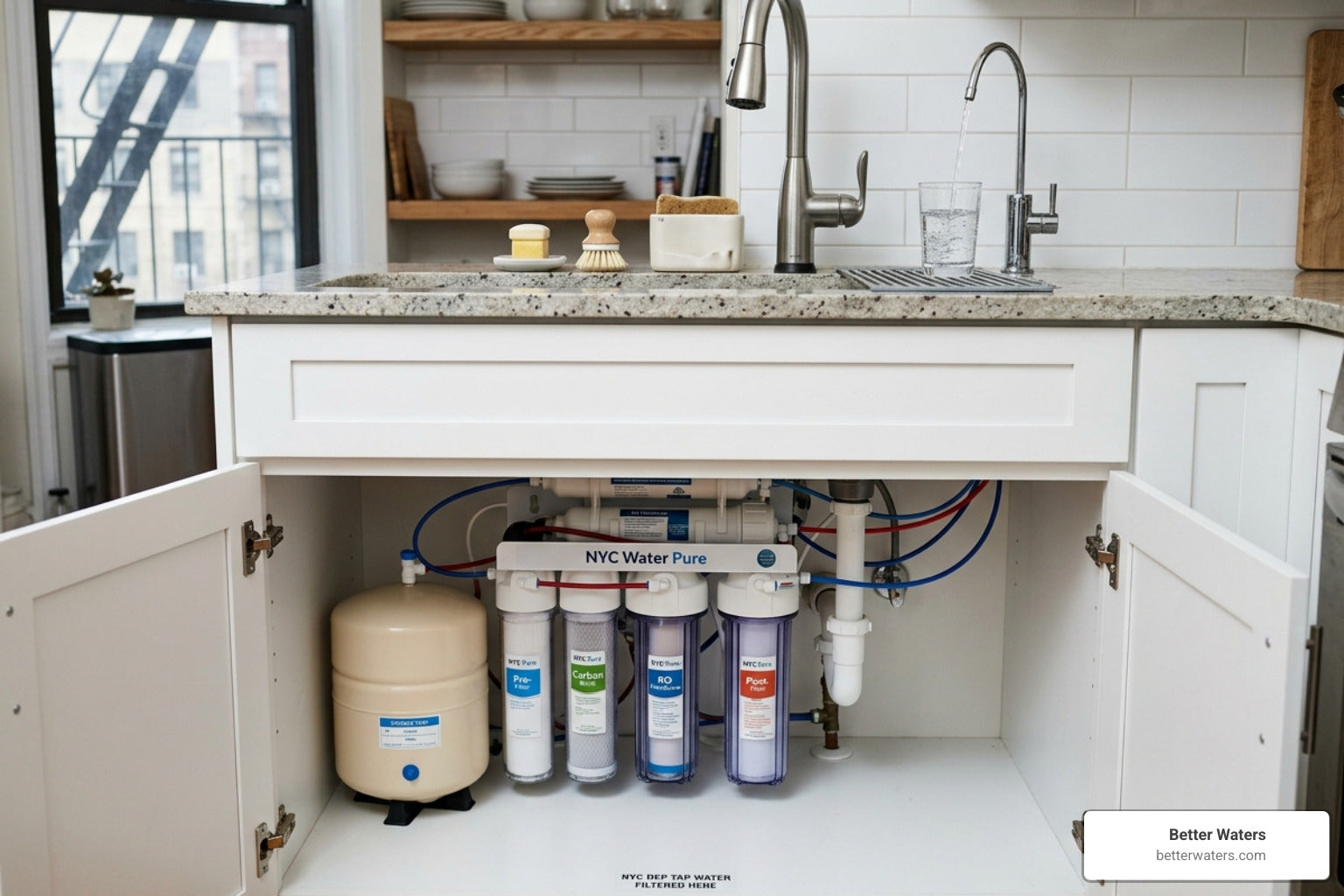
Is Your NYC Tap Water as Clean as You Think?
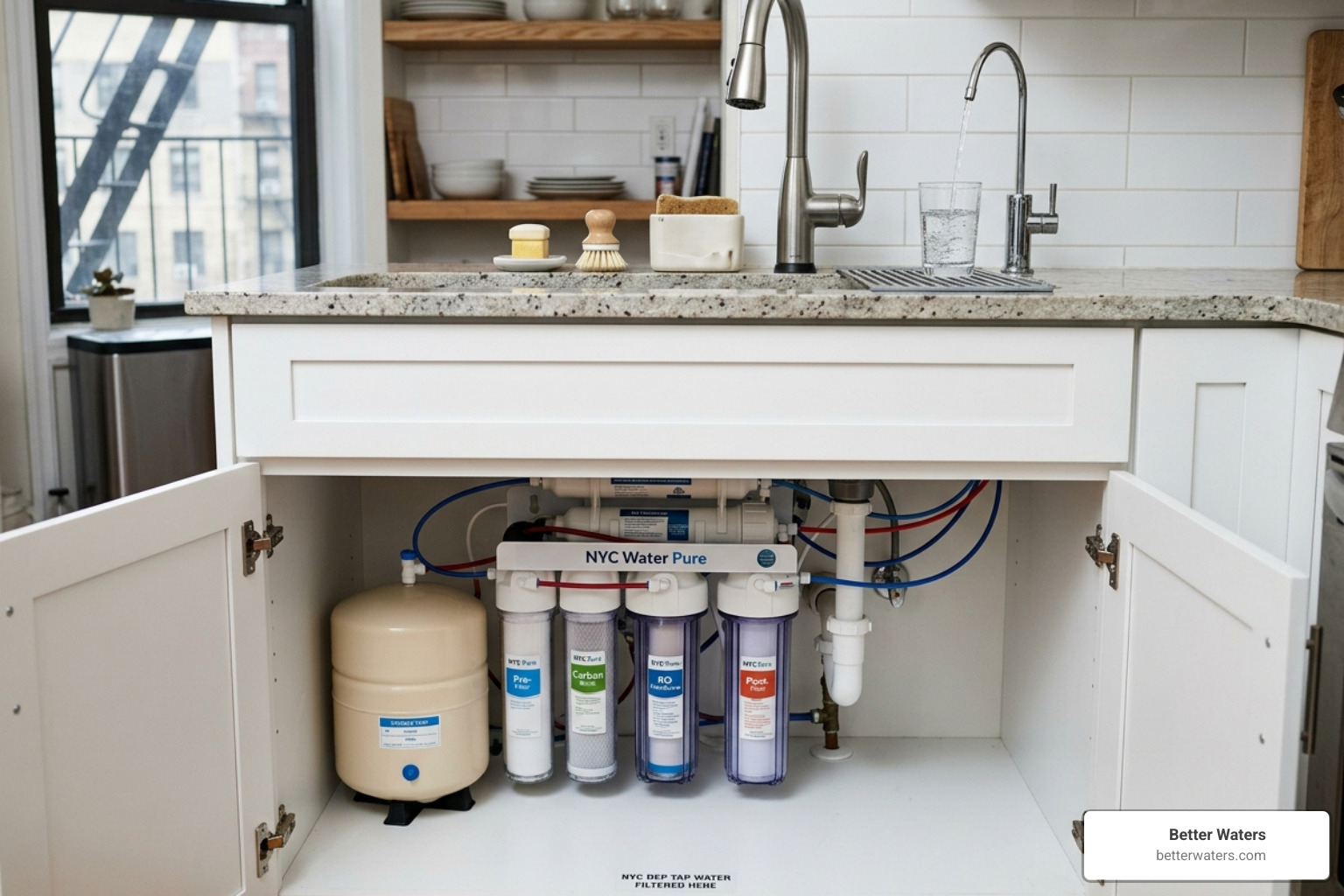
Home water filter NYC options range from simple faucet attachments to advanced under-sink systems.
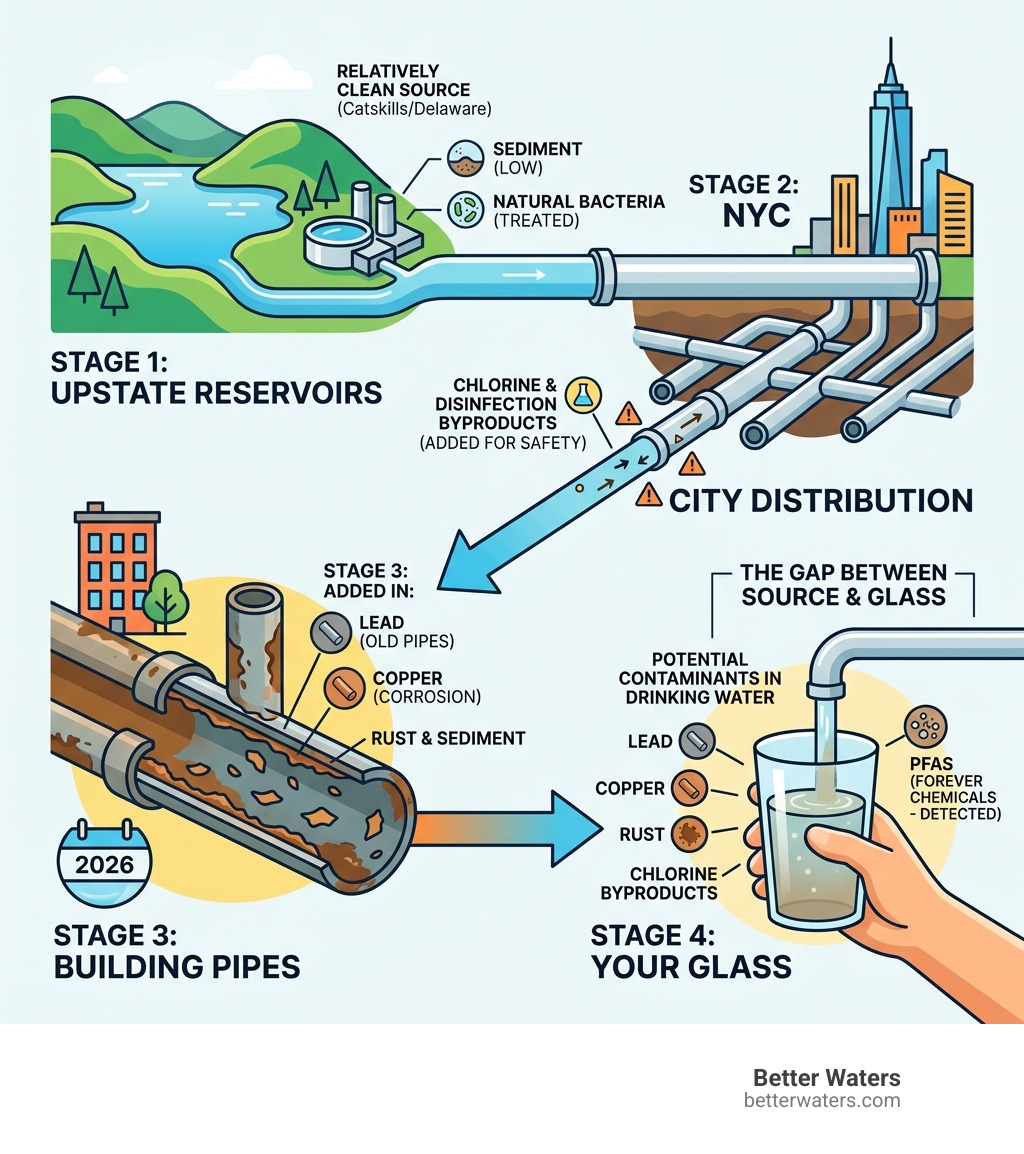
NYC's tap water starts its journey clean. It travels hundreds of miles from upstate reservoirs — and that part, the city largely gets right.
The problem isn't the source. It's what happens after.
By the time water reaches your glass, it has passed through aging pipes, some of which are over a century old and still made of lead or corroded copper. The city treats the water with chlorine, which creates its own chemical byproducts along the way. And increasingly, researchers are detecting PFAS — so-called "forever chemicals" — in New York's water supplies, with studies finding traces in up to 94% of groundwater-based supplies across the state.
So while NYC tap water technically meets federal safety standards at the treatment plant, what comes out of your faucet at home is a different story entirely.
That gap is exactly why more New Yorkers are turning to home filtration — not out of paranoia, but out of practical concern for their health, their families, and frankly, the taste of their water.
This guide cuts through the noise. We'll show you what's actually in your water, which filter types work best for NYC's specific problems, and why a multi-stage carbon system like the XL7000 is one of the most practical solutions available for city apartments today.
Why NYC Tap Water Requires Advanced Filtration
New York City’s water is often called the "Champagne of tap water," but even vintage bubbly can taste like a rusty pipe if it’s served through a dirty straw. The reality of 4 Common Issues with Tap Water - Better Waters Water Filtration is that the water’s quality degrades significantly once it leaves the pristine reservoirs of the Catskills and enters the city's labyrinthine delivery system.

As of April 2026, the primary concerns for New Yorkers aren't just about "dirt" in the water; they are about invisible chemical and metallic threats. The In-home Water Filtration Options for Household Drinking Water provided by the NY Department of Health highlight that while the city does an admirable job at the source, the "last mile" of delivery—the pipes in your street and the plumbing in your building—is where the trouble starts.
Chlorine is added to the water to kill bacteria, which is essential for public health. However, this same chlorine reacts with organic matter to create disinfection byproducts (DBPs) like trihalomethanes. These byproducts, along with heavy metals and sediment, are why your water might occasionally smell like a swimming pool or look slightly "off."
The Impact of Aging Infrastructure on Water Safety
The "Champagne" moniker doesn't account for the fact that much of Manhattan and Brooklyn’s plumbing was installed when the Chrysler Building was still a fresh addition to the skyline. This aging infrastructure means many buildings still rely on lead service lines or lead-soldered copper pipes.
When water sits in these pipes overnight, lead can leach into the supply. This is a primary reason why many residents ask, "Do I Need an Under Sink Water Filter?" The answer is almost always yes if you live in a pre-war building or an area with documented lead service lines.
Beyond lead, the city's century-old sewer systems are prone to overflows during heavy rains, which can occasionally introduce micro-contaminants and sediment into the broader ecosystem.
Understanding PFAS and "Forever Chemicals" in New York
Perhaps the most pressing modern concern is the detection of PFAS (per- and polyfluoroalkyl substances). These "forever chemicals" are used in everything from non-stick pans to firefighting foam and do not break down in the environment—or your body.
Recent data indicates that 94% of groundwater-based water supplies in New York have had PFAS detections. While NYC primarily uses surface water, the interconnected nature of our water tables and the persistence of these chemicals have led health authorities to issue new Scientific research on PFAS reduction guidelines.
Long-term exposure to PFOA and PFOS has been linked to various health risks, making high-quality home water filter nyc systems a vital line of defense for families.
Comparing POU and POE Systems for Urban Living
When looking for a home water filter nyc, you’ll generally choose between two categories: Point-of-Use (POU) and Point-of-Entry (POE).
Point-of-Use (POU): These systems filter water right where you drink it—usually under the kitchen sink or at the faucet. They are the gold standard for NYC apartments because they address the "last mile" of contamination (the building's internal pipes) and don't require modifying the main water line of the entire building.
Point-of-Entry (POE): Also known as "whole house" systems, these are installed where the water line enters the home. While excellent for brownstones or single-family homes in Queens or Staten Island, they are often impractical for apartment dwellers who don't have access to the main riser.
According to our guide on Why a Point-of-Use Water Filter Just Makes Sense for Your Home, POU systems offer the most targeted filtration for drinking and cooking water without the massive footprint or expense of a whole-house unit.
Choosing the Right Home Water Filter NYC for Your Space
NYC living is all about maximizing small spaces. You don't want a filtration system that takes up the entire cabinet where you store your pots and pans.
For most New Yorkers, the under-sink configuration is the "Goldilocks" solution. It provides better filtration than a pitcher but is much easier to manage than a whole-house system.
Cost-Benefit Analysis of a Home Water Filter NYC
Is a home water filter nyc worth the investment? Let's look at the numbers. The average New York family spends about $36 per month on bottled water, which adds up to $432 per year. However, many heavy users spend upwards of $1,460 per year on premium bottled brands.
When Comparing New York City Tap Water Unfiltered with NYC Tap Water Filtered Through the XL7000, the ROI becomes clear. A high-quality system like the XL7000 delivers bottled-quality water for about $0.01 per liter, compared to $0.44 or more for bottled water. Beyond the financial savings, you’re also helping eliminate the 50 billion plastic bottles Americans toss every year—many of which end up in our local waterways.
The Best Home Water Filter NYC: The XL7000 Multi-Stage System
If you are looking for the pinnacle of apartment-friendly filtration, the XL7000 is our top recommendation. Developed with 3M technology, this system is specifically engineered to handle the unique challenges of urban water.
The XL7000 isn't just a single filter; it’s a professional-grade multi-stage powerhouse condensed into one easy-to-manage cartridge. It features a 6,000-gallon capacity, meaning most households only need to change the filter once a year. With a 2.5 GPM (gallons per minute) flow rate, you won’t be standing at the sink waiting for a slow trickle to fill your pasta pot.
The Power of Advanced Carbon Filtration
At the heart of the XL7000 is advanced activated carbon technology. Carbon filtration works through a process called adsorption, where contaminants are trapped in the microscopic pores of the carbon media.
In our breakdown of 6 Reasons to Install an Under-Sink Water Filter, we highlight how this technology is particularly effective at removing:
Chlorine and Chloramines: Eliminating that "bleach" smell and taste.
Volatile Organic Compounds (VOCs): Chemical pollutants that can enter the water supply.
Lead and Heavy Metals: Using specialized media that binds to these dangerous elements.
PFAS: High-density carbon blocks are among the most effective methods for reducing "forever chemicals."
Why High-Flow Systems Matter for NYC Kitchens
Many New Yorkers shy away from filters because they’ve had bad experiences with slow-dripping reverse osmosis tanks or faucet attachments that kill water pressure. 4 Common Issues People Have with Tap Water often include the frustration of low pressure.
The XL7000 solves this with its high-flow design. At 2.5 GPM, it maintains the pressure you expect from your kitchen faucet while providing bottled-quality water instantly. This is "on-demand" filtration—no storage tank required, which also means no risk of bacteria growing in a stagnant tank under your sink.
Maintenance and Performance Standards
A water filter is only as good as its last maintenance check. In NYC, the high level of sediment (often called "pipe scale") can clog low-quality filters quickly.
For the XL7000, maintenance is remarkably simple. The "Sanitary Quick Change" design allows you to swap the cartridge in seconds without touching the filter media or needing a plumber. We recommend an annual service to ensure the carbon remains active and the flow rate stays optimal. As we discuss in "Do I Need an Under Sink Water Filter," consistency is key to long-term health.
How to Identify NSF-Certified Systems
Don't just take a manufacturer's word for it. When shopping for a home water filter nyc, look for NSF/ANSI certifications. These are third-party validations that the system actually does what it claims.
NSF 42: Covers aesthetic effects (chlorine, taste, and odor).
NSF 53: Covers health effects (lead, VOCs, and PFAS).
NSF 401: Covers "emerging" contaminants like pharmaceuticals and microplastics.
The XL7000 uses NSF-certified components to ensure that when we say it removes lead and PFAS, it actually does.
Routine Maintenance for Long-Term Water Purity
To keep your system running perfectly in a city environment:
Change filters annually: Even if the water still tastes "fine," the carbon's ability to chemically bond with toxins like PFAS eventually becomes saturated.
Monitor flow rate: If you notice a sudden drop in pressure, it likely means the filter has successfully trapped a large amount of sediment from a local water main break or building pipe issue.
Check for leaks: Modern systems like the XL7000 are built for durability, but it's always wise to peek under the sink occasionally to ensure all connections remain tight.
Frequently Asked Questions
What are the main contaminants in NYC tap water?
The primary concerns are lead (from aging building pipes), chlorine/chloramines (added by the city), disinfection byproducts (THMs), sediment (rust and scale), and emerging "forever chemicals" like PFAS.
How often should I change my home water filter in NYC?
For a high-capacity system like the XL7000, once every 12 months is standard. However, if you live in a building with very old pipes and high sediment, you might need to change it every 9 months.
Can a water filter remove PFAS and lead effectively?
Yes, but only if it is specifically designed to do so. Look for systems with activated carbon blocks or reverse osmosis membranes that are NSF-certified for lead and PFOA/PFOS reduction.
Conclusion
Living in New York City shouldn't mean compromising on the most basic necessity: clean water. While the city's infrastructure faces challenges from age and modern chemical pollutants, you have the power to protect your home.
The XL7000 system by Better Waters offers a professional-grade, sustainable solution that fits perfectly into the NYC lifestyle. It provides the high flow rate you need for a busy kitchen with the rigorous filtration required to strip away lead, PFAS, and chlorine.
Stop "drinking the pipes" and start enjoying the peace of mind that comes with bottled-quality water directly from your tap.
Share:
The Ultimate Guide to Better Tasting Tap Water
What Does an NSF Approved RO Filter Actually Do